
2022
Fanner, Michael; Whittaker, Karen; Cowley, Sarah Ann
Being orientated towards social justice: Learning for health visitor practice Journal Article
In: Nurse Education Today, vol. 116, pp. 105386, 2022, ISSN: 1532-2793.
Abstract | Links | BibTeX | Tags:
@article{Fanner2022b,

title = {Being orientated towards social justice: Learning for health visitor practice},

author = {Michael Fanner and Karen Whittaker and Sarah Ann Cowley},

doi = {10.1016/j.nedt.2022.105386},

issn = {1532-2793},

year  = {2022},

date = {2022-09-01},

urldate = {2022-09-01},

journal = {Nurse Education Today},

volume = {116},

pages = {105386},

abstract = {Not applicable.},

keywords = {},

pubstate = {published},

tppubtype = {article}

}
Kemp, Lynn; Elcombe, Emma; Sumpton, Wendy; Hook, Beulah; Cowley, Sarah; Byrne, Fiona
Evaluation of the impact of the MECSH programme in England: A mixed methods study Journal Article
In: Journal of Health Visiting, vol. 10, no. 5, pp. 200–214, 2022, ISSN: 2050-8719, (Publisher: Mark Allen Group).
Abstract | Links | BibTeX | Tags: Child protective services, Maternal child health services, Partnership working, Professional–family relations, Programme evaluation, Programme impact
@article{Kemp2022,

title = {Evaluation of the impact of the MECSH programme in England: A mixed methods study},

author = {Lynn Kemp and Emma Elcombe and Wendy Sumpton and Beulah Hook and Sarah Cowley and Fiona Byrne},

doi = {10.12968/johv.2022.10.5.200},

issn = {2050-8719},

year  = {2022},

date = {2022-05-01},

urldate = {2022-05-01},

journal = {Journal of Health Visiting},

volume = {10},

number = {5},

pages = {200–214},

abstract = {The Maternal Early Childhood Sustained Home-visiting (MECSH) programme is a proven, structured intervention from pregnancy or up to 8 weeks after the infant comes home until child age 2, delivered to universal partnership plus or targeted families on each health visitor's caseload. The aim of the study was to show how the MECSH programme, developed in Australia, impacts families in England. The study employed mixed methods including: client demographic data gathered by record audit; parent report data; health visitor focus group; and written testimonies from health visitors and clients. A small comparative study was conducted in one site. The programme reached a diverse range of families. Programme parent-reported measures met quality standards and were higher than in control sites. Health visitors and clients perceived multiple positive parent and child impacts. These positive results support the ongoing implementation of MECSH in England, and warrant further study in a population level trial.},

note = {Publisher: Mark Allen Group},

keywords = {Child protective services, Maternal child health services, Partnership working, Professional–family relations, Programme evaluation, Programme impact},

pubstate = {published},

tppubtype = {article}

}
2018
Cowley, Sarah; Malone, Mary; Whittaker, Karen; Donetto, Sara; Grigulis, Astrida; Maben, Jill
What makes health visiting successful—or not? 2. The service journey Journal Article
In: Journal of Health Visiting, vol. 6, no. 8, pp. 404–412, 2018, ISSN: 2050-8719, (Publisher: Mark Allen Group).
Abstract | Links | BibTeX | Tags: Health equity, health promotion, Health visitors, Maternal–child health services, Proportionate universalism, Universal coverage
@article{Cowley2018,

title = {What makes health visiting successful—or not? 2. The service journey},

author = {Sarah Cowley and Mary Malone and Karen Whittaker and Sara Donetto and Astrida Grigulis and Jill Maben},

doi = {10.12968/johv.2018.6.8.404},

issn = {2050-8719},

year  = {2018},

date = {2018-08-01},

urldate = {2018-08-01},

journal = {Journal of Health Visiting},

volume = {6},

number = {8},

pages = {404–412},

abstract = {This is the second of two articles reporting evidence from a programme of research that focused on how health visiting works, including service user and workforce perspectives. Evidence and professional expertise indicate that a set of essential features enable health visitors to achieve the desired impact of improving child public health. These include organising services in a way that enables positive parent–health visitor relationships, continuity and co-ordination and the flexibility to use professional knowledge and autonomy in practice. Where service specifications give careful attention to this evidence, it is more likely that health visitors will be able to deliver a successful child health programme for the early years.},

note = {Publisher: Mark Allen Group},

keywords = {Health equity, health promotion, Health visitors, Maternal–child health services, Proportionate universalism, Universal coverage},

pubstate = {published},

tppubtype = {article}

}
Cowley, Sarah; Whittaker, Karen; Malone, Mary; Donetto, Sara; Grigulis, Astrida; Maben, Jill
What makes health visiting successful—or not? 1. Universality Journal Article
In: Journal of Health Visiting, vol. 6, no. 7, pp. 352–360, 2018, ISSN: 2050-8719, (Publisher: Mark Allen Group).
Abstract | Links | BibTeX | Tags:
@article{Cowley2018c,

title = {What makes health visiting successful—or not? 1. Universality},

author = {Sarah Cowley and Karen Whittaker and Mary Malone and Sara Donetto and Astrida Grigulis and Jill Maben},

doi = {10.12968/johv.2018.6.7.352},

issn = {2050-8719},

year  = {2018},

date = {2018-07-01},

urldate = {2018-07-01},

journal = {Journal of Health Visiting},

volume = {6},

number = {7},

pages = {352–360},

abstract = {The altered landscape surrounding the commissioning of public health provision has affected the nature and range of health visitor services across England. This is the first of two articles reporting evidence from a programme of research that focused on how health visiting works, also reporting service user and workforce perspectives. Evidence for a service model is offered based on universal principles and maximising the capacity of the health visiting resource. Where service specifications fail to give careful attention to this evidence, the reshaped services for children and families may miss core ingredients that enable health visitors to make a difference, delivering a proportionate and successful child health programme for the early years.},

note = {Publisher: Mark Allen Group},

keywords = {},

pubstate = {published},

tppubtype = {article}

}
2017
Kemp, Lynn; Cowley, Sarah; Byrne, Fiona
Maternal Early Childhood Sustained Home-visiting (MECSH): A UK update Journal Article
In: Journal of Health Visiting, vol. 5, no. 8, pp. 392–397, 2017, ISSN: 2050-8719, (Publisher: Mark Allen Group).
Abstract | Links | BibTeX | Tags:
@article{Kemp2017b,

title = {Maternal Early Childhood Sustained Home-visiting (MECSH): A UK update},

author = {Lynn Kemp and Sarah Cowley and Fiona Byrne},

doi = {10.12968/johv.2017.5.8.392},

issn = {2050-8719},

year  = {2017},

date = {2017-08-01},

urldate = {2017-08-01},

journal = {Journal of Health Visiting},

volume = {5},

number = {8},

pages = {392–397},

abstract = {The Maternal Early Childhood Sustained Home-visiting (MECSH) programme is being implemented in Australia, South Korea, the USA, the UK and the Channel Islands. In the UK, the programme has been implemented at scale in Essex, Plymouth and Lewisham and in regions of Somerset as part of a trial. The purpose of this article is to provide an overview of the MECSH programme and outline the evidence of the programme's effectiveness, fit for the UK context, and research that is still in progress; and explore how the programme achieves changes in outcomes for families and children.},

note = {Publisher: Mark Allen Group},

keywords = {},

pubstate = {published},

tppubtype = {article}

}
Bryar, Rosamund; Cowley, Sarah; Adams, Cheryll; Kendall, Sally; Mathers, Nigel
Health visiting in primary care in England: a crisis waiting to happen? Journal Article
In: British Journal of General Practice, vol. 67, pp. 102–103, 2017.
@article{bryar_health_2017,

title = {Health visiting in primary care in England: a crisis waiting to happen?},

author = {Rosamund Bryar and Sarah Cowley and Cheryll Adams and Sally Kendall and Nigel Mathers},

doi = {10.3399/bjgp17X689449},

year  = {2017},

date = {2017-03-01},

urldate = {2017-03-01},

journal = {British Journal of General Practice},

volume = {67},

pages = {102–103},

keywords = {},

pubstate = {published},

tppubtype = {article}

}
Bidmead, Christine; Cowley, Sarah; Grocott, Patricia
Measuring the parent/health visitor relationship: Piloting the questionnaires Journal Article
In: Journal of Health Visiting, vol. 5, no. 2, pp. 72–80, 2017, ISSN: 2050-8719, (Publisher: Mark Allen Group).
Abstract | Links | BibTeX | Tags: Health visitor relationships, Measurement indicators, qualitative research, Qualities, Relational skills
@article{Bidmead2017b,

title = {Measuring the parent/health visitor relationship: Piloting the questionnaires},

author = {Christine Bidmead and Sarah Cowley and Patricia Grocott},

url = {undefined},

doi = {10.12968/johv.2017.5.2.72},

issn = {2050-8719},

year  = {2017},

date = {2017-02-01},

urldate = {2017-02-01},

journal = {Journal of Health Visiting},

volume = {5},

number = {2},

pages = {72–80},

abstract = {This final paper of five presents the steps taken to construct and pilot questionnaires to measure the parent/health visitor (HV) relationship. Construction of the questionnaires built on evidence from qualitative research undertaken with parents and HVs, and was presented in the previous papers. The questionnaires were piloted in the community, with involvement from parents and HVs to adjust the wording of statements for ease of understanding and clarity, and to ensure construct validity and reliability. The questionnaires proved acceptable and understandable to parents and HVs who quickly completed them. Statistical analysis confirmed that the questionnaires were sensitive to different relationships and that, overall, HVs had positive relationships with parents. The clinical significance of the evidence was also analysed.},

note = {Publisher: Mark Allen Group},

keywords = {Health visitor relationships, Measurement indicators, qualitative research, Qualities, Relational skills},

pubstate = {published},

tppubtype = {article}

}
Whittaker, Karen A.; Malone, Mary; Cowley, Sarah; Grigulis, Astrida; Nicholson, Caroline; Maben, Jill
Making a difference for children and families: an appreciative inquiry of health visitor values and why they start and stay in post Journal Article
In: Health & Social Care in the Community, vol. 25, no. 2, pp. 338–348, 2017, ISSN: 1365-2524, (_eprint: https://onlinelibrary.wiley.com/doi/pdf/10.1111/hsc.12307).
Abstract | Links | BibTeX | Tags: employment, health visiting, professional values, psychological contract, recruitment and retention
@article{Whittaker2017,

title = {Making a difference for children and families: an appreciative inquiry of health visitor values and why they start and stay in post},

author = {Karen A. Whittaker and Mary Malone and Sarah Cowley and Astrida Grigulis and Caroline Nicholson and Jill Maben},

doi = {10.1111/hsc.12307},

issn = {1365-2524},

year  = {2017},

date = {2017-01-01},

urldate = {2017-01-01},

journal = {Health & Social Care in the Community},

volume = {25},

number = {2},

pages = {338–348},

abstract = {The study aimed to develop an understanding of health visitor recruitment and retention by examining what existing staff and new recruits wanted from their job, their professional aspirations and what would encourage them to start and stay in employment. Following a period of steady decline in numbers, the health visitor workforce in England has recently been invested in and expanded to deliver universal child public health. To capitalise on this large investment, managers need an understanding of factors influencing workforce retention and continuing recruitment of health visitors. The study was designed using an interpretive approach and involved students (n = 17) and qualified health visitors (n = 22) from the north and south of England. Appreciative inquiry (AI) exercises were used as methods of data collection during 2012. During AI exercises students and health visitors wrote about ‘a practice experience you have felt excited and motivated by and briefly describe the factors that contributed to this’. Participants were invited to discuss their written accounts of practice with a peer during an audio-recorded sharing session. Participants gave consent for written accounts and transcribed recordings to be used as study data, which was examined using framework analysis. In exploring personal meanings of health visiting, participants spoke about the common aspiration to make a difference to children and families. To achieve this, they expected their job to allow them to: connect with families; work with others; use their knowledge, skills and experience; use professional autonomy. The study offers new insights into health visitors’ aspirations, showing consistency with conceptual explanations of optimal professional practice. Psychological contract theory illustrates connections between professional aspirations and work commitment. Managers can use these findings as part of workforce recruitment and retention strategies and for building on the health visitor commitment to making a difference to children and families.},

note = {_eprint: https://onlinelibrary.wiley.com/doi/pdf/10.1111/hsc.12307},

keywords = {employment, health visiting, professional values, psychological contract, recruitment and retention},

pubstate = {published},

tppubtype = {article}

}
2016
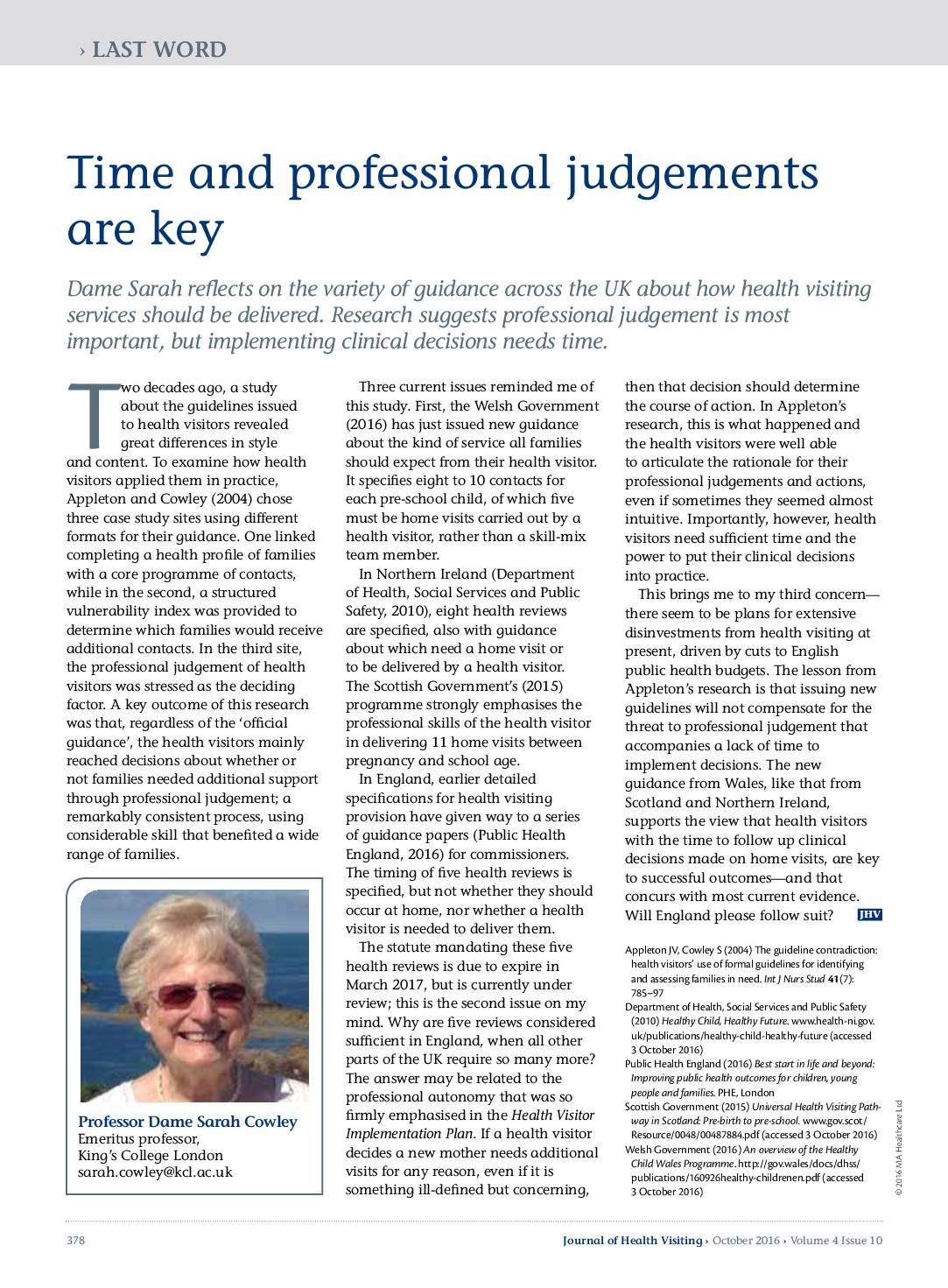
Cowley, Dame Sarah
Time and professional judgements are key Journal Article
In: Journal of Health Visiting, vol. 4, no. 10, pp. 534–534, 2016, ISSN: 2050-8719, (Publisher: Mark Allen Group).
Abstract | Links | BibTeX | Tags:
@article{Cowley2016,

title = {Time and professional judgements are key},

author = {Dame Sarah Cowley},

doi = {10.12968/johv.2016.4.10.534},

issn = {2050-8719},

year  = {2016},

date = {2016-10-01},

urldate = {2016-10-01},

journal = {Journal of Health Visiting},

volume = {4},

number = {10},

pages = {534–534},

abstract = {Dame Sarah reflects on the variety of guidance across the UK about how health visiting services should be delivered. Research suggests professional judgement is most important, but implementing clinical decisions needs time.},

note = {Publisher: Mark Allen Group},

keywords = {},

pubstate = {published},

tppubtype = {article}

}
Malone, Mary; Whittaker, Karen A.; Cowley, Sarah; Ezhova, Ivanka; Maben, Jill
Health visitor education for today's Britain: Messages from a narrative review of the health visitor literature Journal Article
In: Nurse Education Today, vol. 44, pp. 175–186, 2016, ISSN: 0260-6917.
Abstract | Links | BibTeX | Tags: Health visitor education, Health visitor practice, International, Knowledge, Narrative review, Public health nurse, skills and abilities
@article{Malone2016,

title = {Health visitor education for today's Britain: Messages from a narrative review of the health visitor literature},

author = {Mary Malone and Karen A. Whittaker and Sarah Cowley and Ivanka Ezhova and Jill Maben},

doi = {10.1016/j.nedt.2016.04.007},

issn = {0260-6917},

year  = {2016},

date = {2016-09-01},

urldate = {2016-09-01},

journal = {Nurse Education Today},

volume = {44},

pages = {175–186},

abstract = {Objectives


This paper draws on a narrative review of the literature, commissioned to support the Health Visitor Implementation Plan, and aimed at identifying messages about the knowledge, skills, and abilities needed by health visitors to work within the current system of health care provision.


Design


The scoping study and narrative review used three complementary approaches: a broad search, a structured search, and a seminal paper search to identify empirical papers from the health visitor literature for review. The key inclusion criteria were messages of relevance for practice.


Data Sources


378 papers were reviewed. These included empirical papers from the United Kingdom (UK) from 2004 to February 2012, older research identified in the seminal paper search and international literature from 2000 to January 2016.


Review Methods


The review papers were read by members of the multidisciplinary research team which included health visitor academics, social scientists, and a clinical psychologist managed the international literature. Thematic content analysis was used to identify main messages. These were tabulated and shared between researchers in order to compare emergent findings and to confirm dominant themes.


Results


The analysis identified an ‘orientation to practice’ based on salutogenesis (health creation), human valuing (person-centred care), and viewing the person in situation (human ecology) as the aspirational core of health visitors' work. This was realised through home visiting, needs assessment, and relationship formation at different levels of service provision. A wide range of knowledge, skills, and abilities were required, including knowledge of health as a process and skills in engagement, building trust, and making professional judgments. These are currently difficult to impart within a 45week health visitor programme and are facilitated through ad hoc post-registration education and training. The international literature reported both similarities and differences between the working practices of health visitors in the UK and public health nurses worldwide. Challenges related to the education of each were identified.


Conclusions


The breadth and scope of knowledge, skills, and abilities required by health visitors make a review of current educational provision desirable. Three potential models for health visitor education are described.},

keywords = {Health visitor education, Health visitor practice, International, Knowledge, Narrative review, Public health nurse, skills and abilities},

pubstate = {published},

tppubtype = {article}

}
This paper draws on a narrative review of the literature, commissioned to support the Health Visitor Implementation Plan, and aimed at identifying messages about the knowledge, skills, and abilities needed by health visitors to work within the current system of health care provision.
Design
The scoping study and narrative review used three complementary approaches: a broad search, a structured search, and a seminal paper search to identify empirical papers from the health visitor literature for review. The key inclusion criteria were messages of relevance for practice.
Data Sources
378 papers were reviewed. These included empirical papers from the United Kingdom (UK) from 2004 to February 2012, older research identified in the seminal paper search and international literature from 2000 to January 2016.
Review Methods
The review papers were read by members of the multidisciplinary research team which included health visitor academics, social scientists, and a clinical psychologist managed the international literature. Thematic content analysis was used to identify main messages. These were tabulated and shared between researchers in order to compare emergent findings and to confirm dominant themes.
Results
The analysis identified an ‘orientation to practice’ based on salutogenesis (health creation), human valuing (person-centred care), and viewing the person in situation (human ecology) as the aspirational core of health visitors' work. This was realised through home visiting, needs assessment, and relationship formation at different levels of service provision. A wide range of knowledge, skills, and abilities were required, including knowledge of health as a process and skills in engagement, building trust, and making professional judgments. These are currently difficult to impart within a 45week health visitor programme and are facilitated through ad hoc post-registration education and training. The international literature reported both similarities and differences between the working practices of health visitors in the UK and public health nurses worldwide. Challenges related to the education of each were identified.
Conclusions
The breadth and scope of knowledge, skills, and abilities required by health visitors make a review of current educational provision desirable. Three potential models for health visitor education are described.
Bidmead, Christine; Cowley, Sarah; Grocott, Patricia
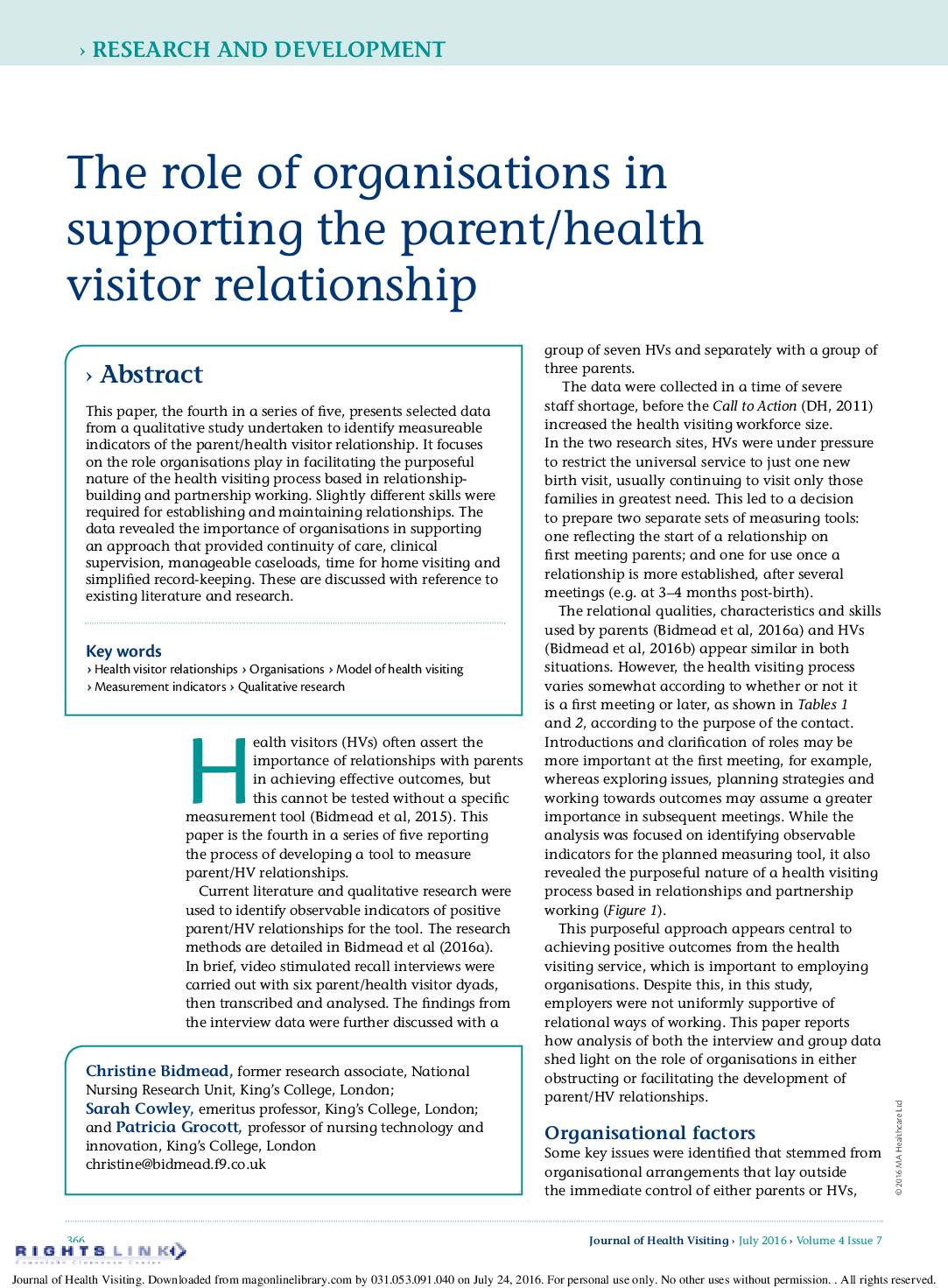
The role of organisations in supporting the parent/health visitor relationship Journal Article
In: Journal of Health Visiting, vol. 4, no. 7, pp. 366–374, 2016, ISSN: 2050-8719, (Publisher: Mark Allen Group).
Abstract | Links | BibTeX | Tags: Health visitor relationships, Measurement indicators, Model of health visiting, Organisations, qualitative research
@article{Bidmead2016,

title = {The role of organisations in supporting the parent/health visitor relationship},

author = {Christine Bidmead and Sarah Cowley and Patricia Grocott},

url = {undefined},

doi = {10.12968/johv.2016.4.7.366},

issn = {2050-8719},

year  = {2016},

date = {2016-07-01},

urldate = {2016-07-01},

journal = {Journal of Health Visiting},

volume = {4},

number = {7},

pages = {366–374},

abstract = {This paper, the fourth in a series of five, presents selected data from a qualitative study undertaken to identify measureable indicators of the parent/health visitor relationship. It focuses on the role organisations play in facilitating the purposeful nature of the health visiting process based in relationship-building and partnership working. Slightly different skills were required for establishing and maintaining relationships. The data revealed the importance of organisations in supporting an approach that provided continuity of care, clinical supervision, manageable caseloads, time for home visiting and simplified record-keeping. These are discussed with reference to existing literature and research.},

note = {Publisher: Mark Allen Group},

keywords = {Health visitor relationships, Measurement indicators, Model of health visiting, Organisations, qualitative research},

pubstate = {published},

tppubtype = {article}

}
Cowley, Dame Sarah
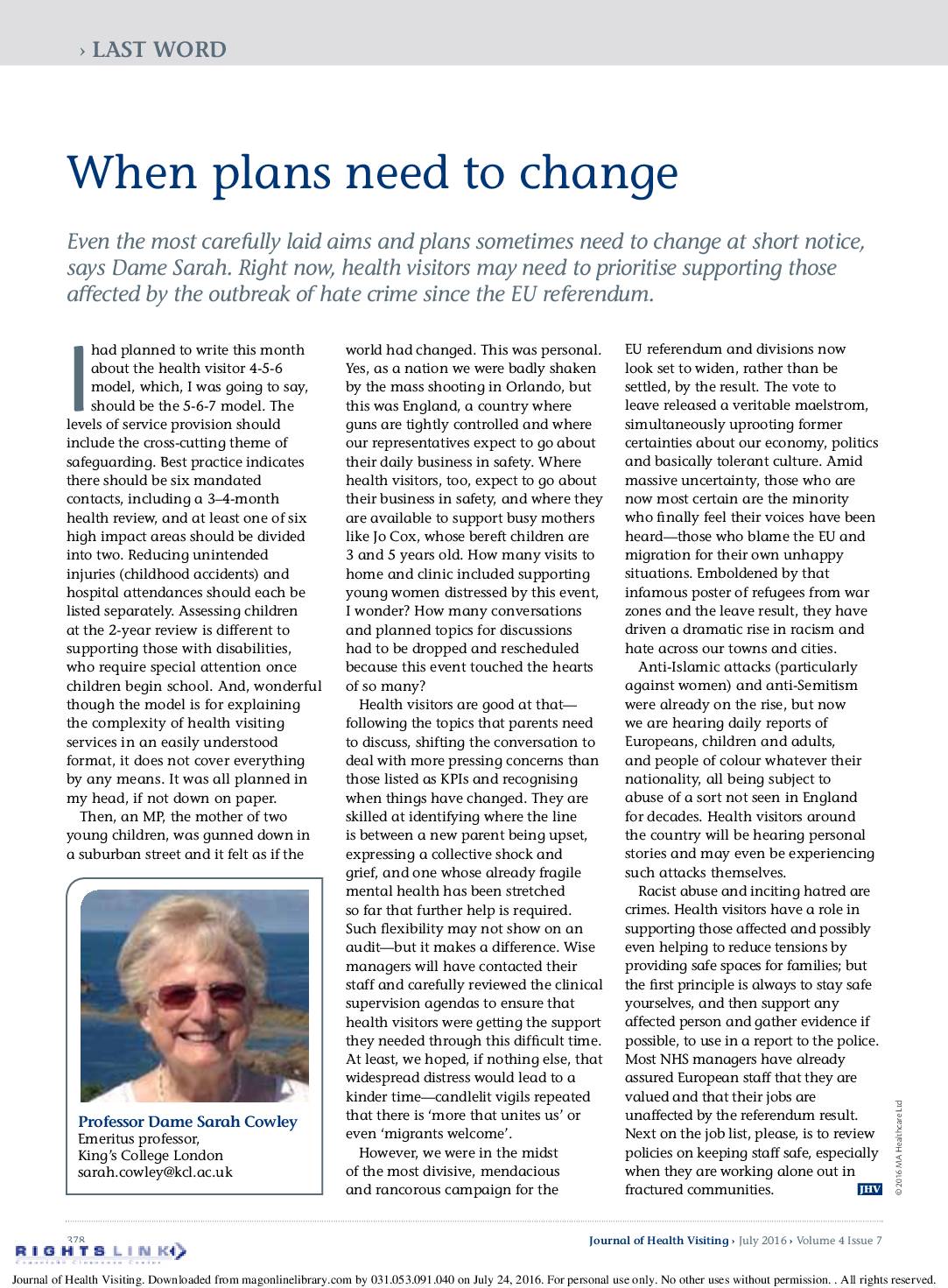
When plans need to change Journal Article
In: Journal of Health Visiting, vol. 4, no. 7, pp. 378–378, 2016, ISSN: 2050-8719, (Publisher: Mark Allen Group).
Abstract | Links | BibTeX | Tags:
@article{Cowley2016b,

title = {When plans need to change},

author = {Dame Sarah Cowley},

doi = {10.12968/johv.2016.4.7.378},

issn = {2050-8719},

year  = {2016},

date = {2016-07-01},

urldate = {2016-07-01},

journal = {Journal of Health Visiting},

volume = {4},

number = {7},

pages = {378–378},

abstract = {Even the most carefully laid aims and plans sometimes need to change at short notice, says Dame Sarah. Right now, health visitors may need to prioritise supporting those affected by the outbreak of hate crime since the EU referendum.},

note = {Publisher: Mark Allen Group},

keywords = {},

pubstate = {published},

tppubtype = {article}

}
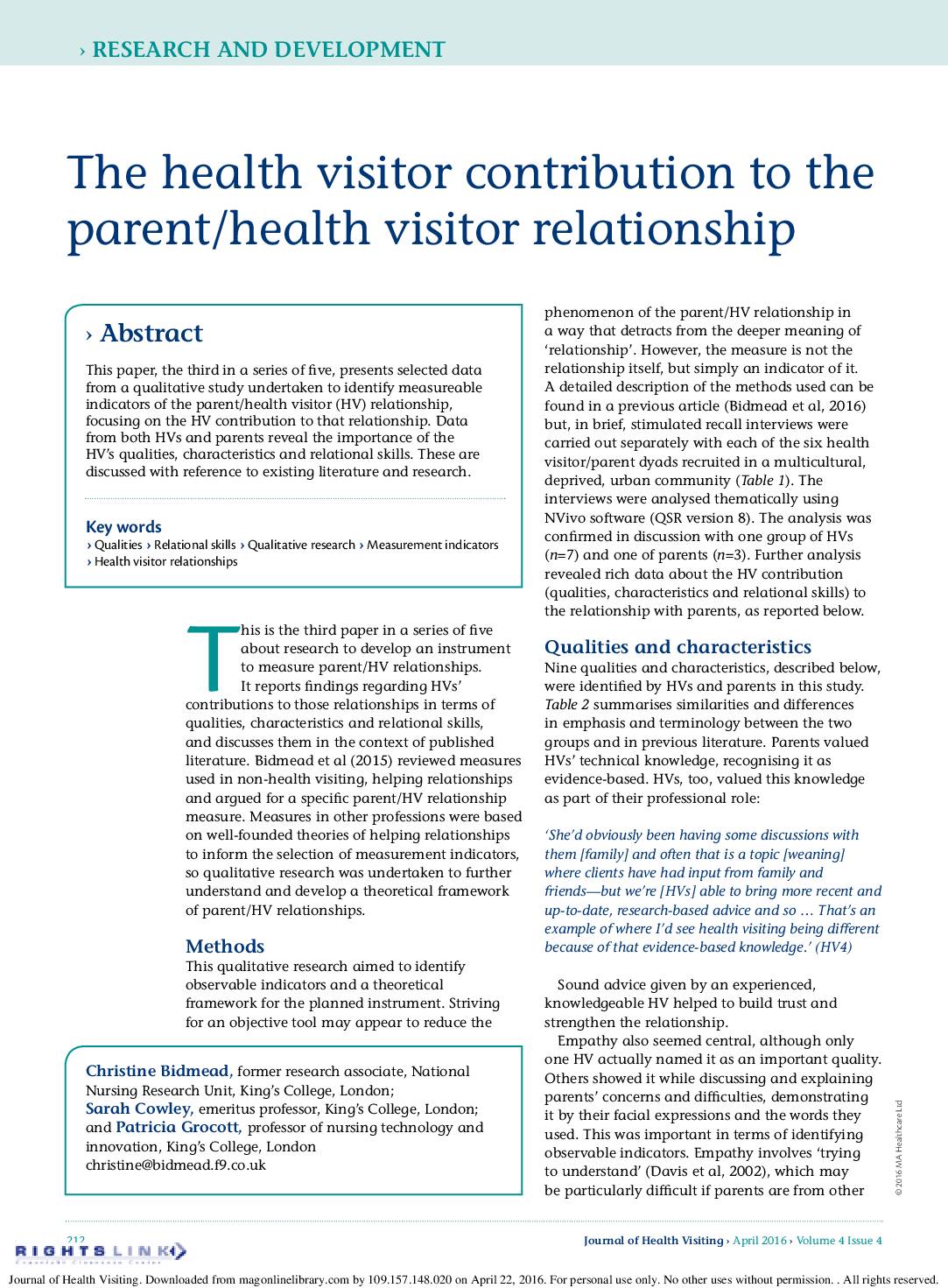
Bidmead, Christine; Cowley, Sarah; Grocott, Patricia
The health visitor contribution to the parent/health visitor relationship Journal Article
In: Journal of Health Visiting, vol. 4, no. 4, pp. 212–220, 2016, ISSN: 2050-8719, (Publisher: Mark Allen Group).
Abstract | Links | BibTeX | Tags: Health visitor relationships, Measurement indicators, qualitative research, Qualities, Relational skills
@article{Bidmead2016b,

title = {The health visitor contribution to the parent/health visitor relationship},

author = {Christine Bidmead and Sarah Cowley and Patricia Grocott},

doi = {10.12968/johv.2016.4.4.212},

issn = {2050-8719},

year  = {2016},

date = {2016-04-01},

urldate = {2016-04-01},

journal = {Journal of Health Visiting},

volume = {4},

number = {4},

pages = {212–220},

abstract = {This paper, the third in a series of five, presents selected data from a qualitative study undertaken to identify measureable indicators of the parent/health visitor (HV) relationship, focusing on the HV contribution to that relationship. Data from both HVs and parents reveal the importance of the HV's qualities, characteristics and relational skills. These are discussed with reference to existing literature and research.},

note = {Publisher: Mark Allen Group},

keywords = {Health visitor relationships, Measurement indicators, qualitative research, Qualities, Relational skills},

pubstate = {published},

tppubtype = {article}

}
Cowley, Dame Sarah
Signposting the NHS for migrants Journal Article
In: Journal of Health Visiting, vol. 4, no. 4, pp. 222–222, 2016, ISSN: 2050-8719, (Publisher: Mark Allen Group).
Abstract | Links | BibTeX | Tags:
@article{Cowley2016c,

title = {Signposting the NHS for migrants},

author = {Dame Sarah Cowley},

doi = {10.12968/johv.2016.4.4.222},

issn = {2050-8719},

year  = {2016},

date = {2016-04-01},

urldate = {2016-04-01},

journal = {Journal of Health Visiting},

volume = {4},

number = {4},

pages = {222–222},

abstract = {One sunny Sunday in March, Dame Sarah Cowley made her way to the Google Campus in London to judge the 2-day NHS Navigation Hackathon, a competition to design a new app to help migrants and refugees find their way around the NHS.},

note = {Publisher: Mark Allen Group},

keywords = {},

pubstate = {published},

tppubtype = {article}

}
Bidmead, Christine; Cowley, Sarah; Grocott, Patricia
The parental contribution to the parent/health visitor relationship Journal Article
In: Journal of Health Visiting, vol. 4, no. 1, pp. 48–55, 2016, ISSN: 2050-8719, (Publisher: Mark Allen Group).
Abstract | Links | BibTeX | Tags: Health visitor, Parent, Qualities, Relationship, Skills, Stimulated recall
@article{Bidmead2016c,

title = {The parental contribution to the parent/health visitor relationship},

author = {Christine Bidmead and Sarah Cowley and Patricia Grocott},

url = {https://www.magonlinelibrary.com/doi/abs/10.12968/johv.2016.4.1.48},

doi = {10.12968/johv.2016.4.1.48},

issn = {2050-8719},

year  = {2016},

date = {2016-01-01},

urldate = {2016-01-01},

journal = {Journal of Health Visiting},

volume = {4},

number = {1},

pages = {48–55},

abstract = {This paper reports the qualitative methods used and the findings that inform a theoretical framework suitable for measuring parent/health visitor (HV) relationships. Focusing on the parental contribution to the parent/HV relationship, the qualities and skills identified by health visitors and parents during stimulated recall processes are presented. These findings are discussed in the context of existing research.},

note = {Publisher: Mark Allen Group},

keywords = {Health visitor, Parent, Qualities, Relationship, Skills, Stimulated recall},

pubstate = {published},

tppubtype = {article}

}
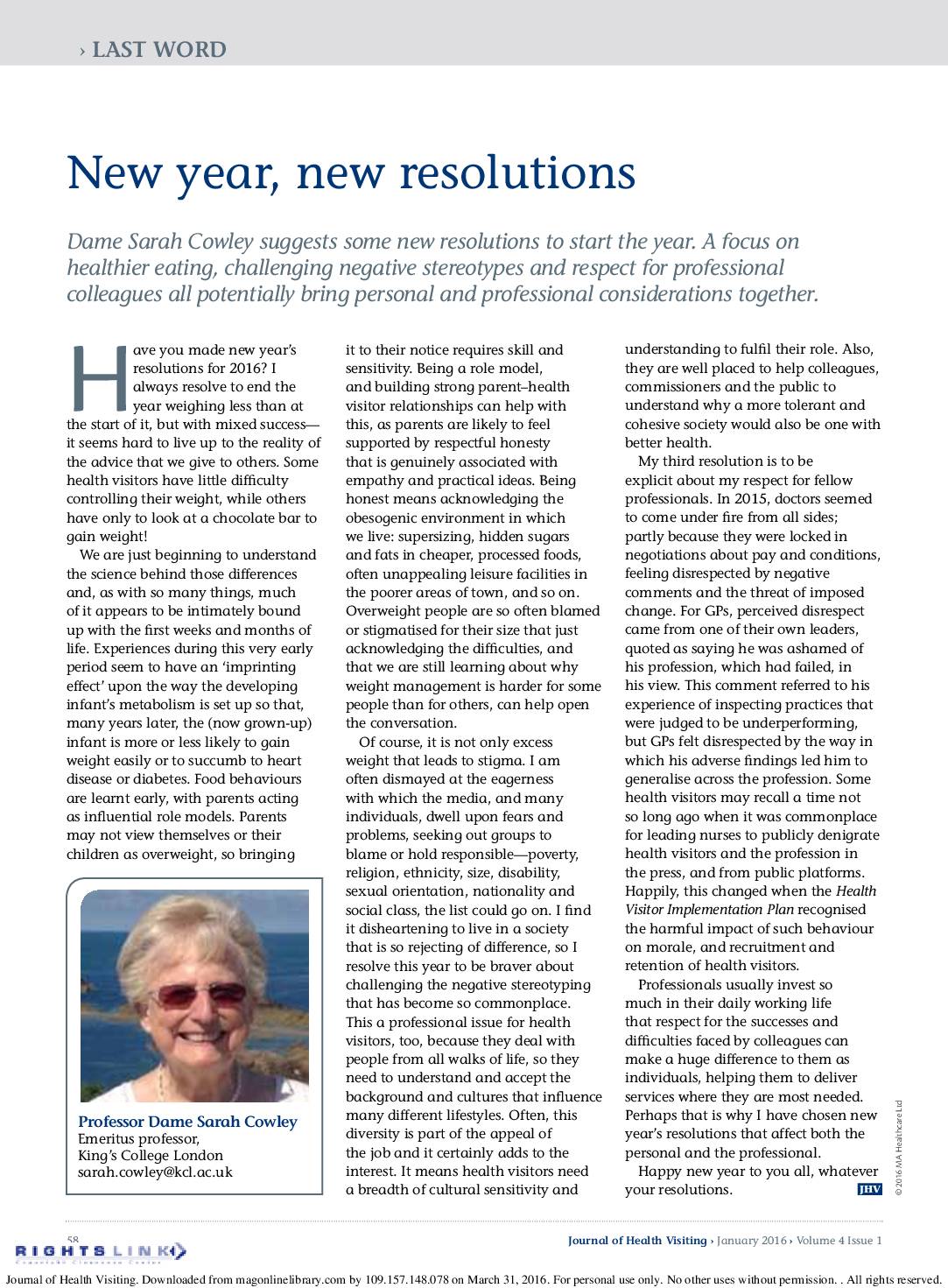
Cowley, Dame Sarah
New year, new resolutions Journal Article
In: Journal of Health Visiting, vol. 4, no. 1, pp. 58–58, 2016, ISSN: 2050-8719, (Publisher: Mark Allen Group).
Abstract | Links | BibTeX | Tags:
@article{Cowley2016d,

title = {New year, new resolutions},

author = {Dame Sarah Cowley},

doi = {10.12968/johv.2016.4.1.58},

issn = {2050-8719},

year  = {2016},

date = {2016-01-01},

urldate = {2016-01-01},

journal = {Journal of Health Visiting},

volume = {4},

number = {1},

pages = {58–58},

abstract = {Dame Sarah Cowley suggests some new resolutions to start the year. A focus on healthier eating, challenging negative stereotypes and respect for professional colleagues all potentially bring personal and professional considerations together.},

note = {Publisher: Mark Allen Group},

keywords = {},

pubstate = {published},

tppubtype = {article}

}
2015
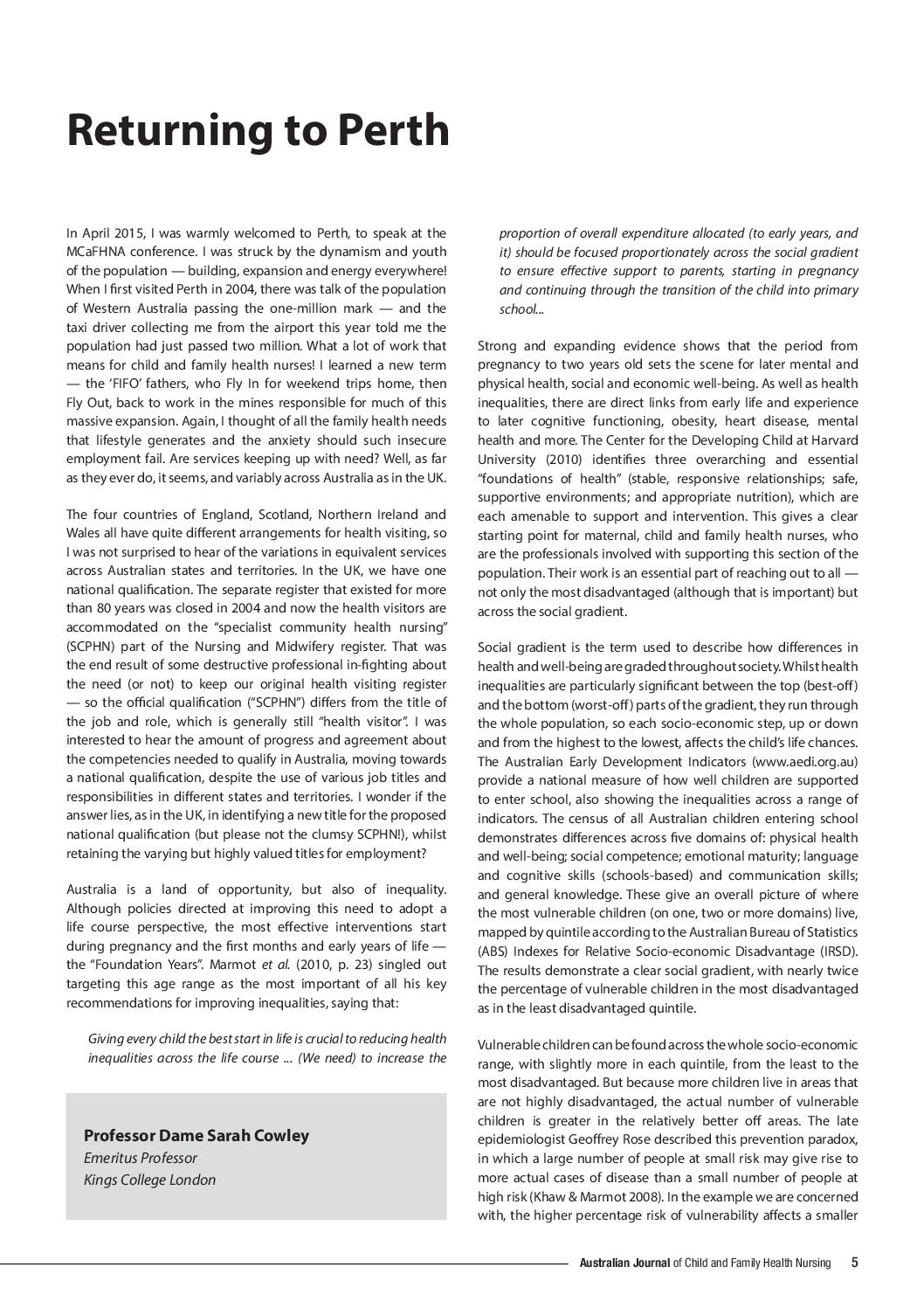
Cowley, Dame Sarah
Returning to Perth Journal Article
In: Australian Journal of Child and Family Health Nursing, vol. 12, no. 2, pp. 5–6, 2015, (Publisher: Cambridge Publishing).
Abstract | Links | BibTeX | Tags: Children–Health and hygiene, Families–Health and hygiene, Pregnant women–Health and hygiene, Visiting nurses, Vulnerability (Personality trait), Well-being, Western Australia–Perth
@article{Cowley2015,

title = {Returning to Perth},

author = {Dame Sarah Cowley},

doi = {10.3316/informit.760881511278667},

year  = {2015},

date = {2015-12-01},

urldate = {2015-12-01},

journal = {Australian Journal of Child and Family Health Nursing},

volume = {12},

number = {2},

pages = {5–6},

abstract = {In April 2015, I was warmly welcomed to Perth, to speak at the MCaFHNA conference. I was struck by the dynamism and youth of the population - building, expansion and energy everywhere! When I first visited Perth in 2004, there was talk of the population of Western Australia passing the one-million mark - and the taxi driver collecting me from the airport this year told me the population had just passed two million. What a lot of work that means for child and family health nurses! I learned a new term - the 'FIFO' fathers, who Fly In for weekend trips home, then Fly Out, back to work in the mines responsible for much of this massive expansion. Again, I thought of all the family health needs that lifestyle generates and the anxiety should such insecure employment fail. Are services keeping up with need? Well, as far as they ever do, it seems, and variably across Australia as in the UK.},

note = {Publisher: Cambridge Publishing},

keywords = {Children–Health and hygiene, Families–Health and hygiene, Pregnant women–Health and hygiene, Visiting nurses, Vulnerability (Personality trait), Well-being, Western Australia–Perth},

pubstate = {published},

tppubtype = {article}

}
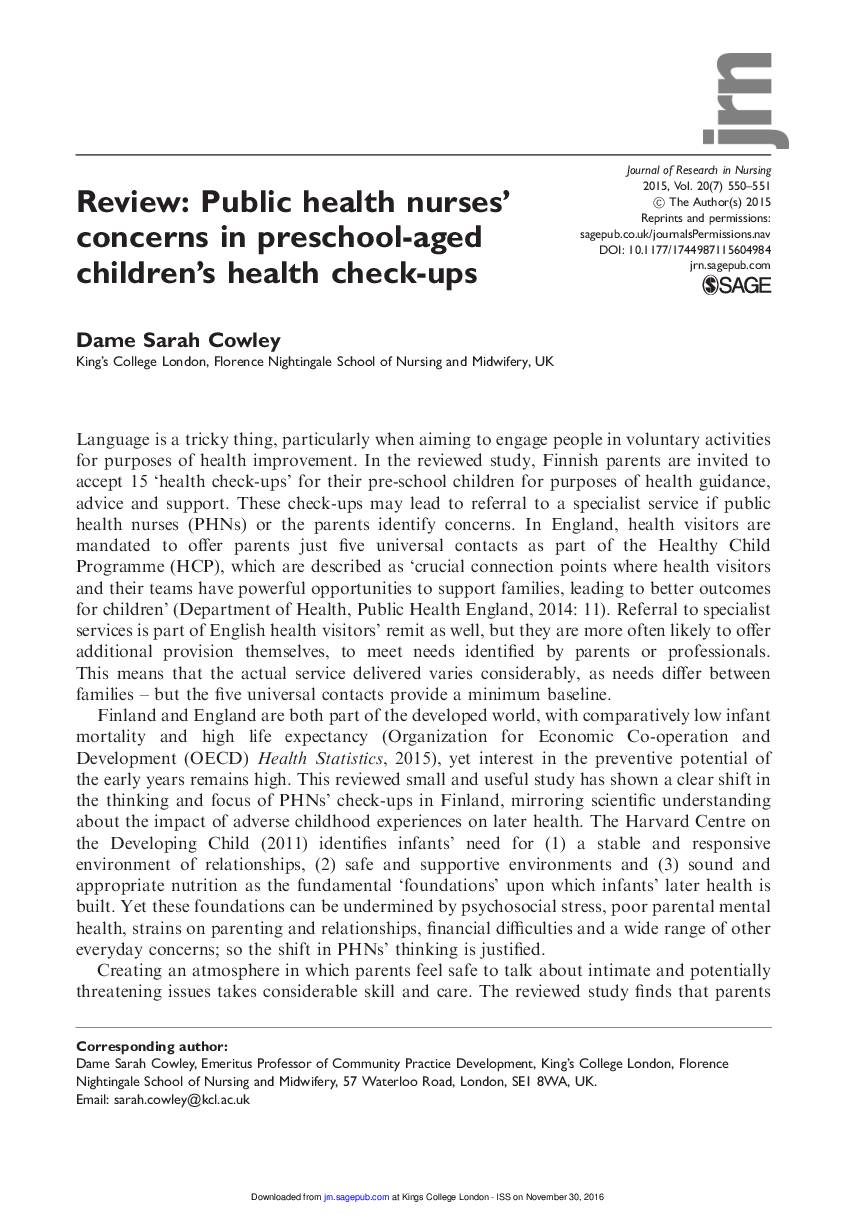
Cowley, Dame Sarah
Review: Public health nurses’ concerns in preschool-aged children’s health check-ups Journal Article
In: Journal of Research in Nursing, vol. 20, no. 7, pp. 550–551, 2015, ISSN: 1744-9871, (Publisher: SAGE Publications Ltd).
@article{Cowley2015b,

title = {Review: Public health nurses’ concerns in preschool-aged children’s health check-ups},

author = {Dame Sarah Cowley},

doi = {10.1177/1744987115604984},

issn = {1744-9871},

year  = {2015},

date = {2015-11-01},

urldate = {2015-11-01},

journal = {Journal of Research in Nursing},

volume = {20},

number = {7},

pages = {550–551},

note = {Publisher: SAGE Publications Ltd},

keywords = {},

pubstate = {published},

tppubtype = {article}

}
Bidmead, Christine; Cowley, Sarah; Grocott, Patricia
Investigating the parent/health visitor relationship: Can it be measured? Journal Article
In: Journal of Health Visiting, vol. 3, no. 10, pp. 548–558, 2015, ISSN: 2050-8719, (Publisher: Mark Allen Group).
Abstract | Links | BibTeX | Tags: Parent/health visitor relationship, Partnership, Relationship measures, Theories of helping relationships, Therapeutic relationship
@article{Bidmead2015,

title = {Investigating the parent/health visitor relationship: Can it be measured?},

author = {Christine Bidmead and Sarah Cowley and Patricia Grocott},

doi = {10.12968/johv.2015.3.10.548},

issn = {2050-8719},

year  = {2015},

date = {2015-10-01},

urldate = {2015-10-01},

journal = {Journal of Health Visiting},

volume = {3},

number = {10},

pages = {548–558},

abstract = {The claim that parent/health visitor (HV) relationships are essential for positive outcomes is widely supported, but also contested. Within psychotherapy and other helping professions, researchers have developed measures to demonstrate that the relationship with the therapist is, indeed, linked to positive outcomes. In health visiting no such tools exist, so there is no way to measure any potential benefits from the relationship. This paper explores the reasons why measures used in psychotherapy and other helping relationships may be unsuitable for measuring parent/HV relationships. It reviews a number of measures used and argues the need for a specific parent/HV relationship tool.},

note = {Publisher: Mark Allen Group},

keywords = {Parent/health visitor relationship, Partnership, Relationship measures, Theories of helping relationships, Therapeutic relationship},

pubstate = {published},

tppubtype = {article}

}
Cowley, Dame Sarah
Mothers work Journal Article
In: Journal of Health Visiting, vol. 3, no. 10, pp. 566–566, 2015, ISSN: 2050-8719, (Publisher: Mark Allen Group).
Abstract | Links | BibTeX | Tags:
@article{Cowley2015c,

title = {Mothers work},

author = {Dame Sarah Cowley},

doi = {10.12968/johv.2015.3.10.566},

issn = {2050-8719},

year  = {2015},

date = {2015-10-01},

urldate = {2015-10-01},

journal = {Journal of Health Visiting},

volume = {3},

number = {10},

pages = {566–566},

abstract = {Health visitors may be party to mothers' deliberations about when, or if, to return to work after maternity leave—but whatever their choice, they need support and for their contribution of caring in the home to be valued.},

note = {Publisher: Mark Allen Group},

keywords = {},

pubstate = {published},

tppubtype = {article}

}
Cowley, Dame Sarah
Poverty may pay Journal Article
In: Journal of Health Visiting, vol. 3, no. 7, pp. 402–402, 2015, ISSN: 2050-8719, (Publisher: Mark Allen Group).
@article{Cowley2015d,

title = {Poverty may pay},

author = {Dame Sarah Cowley},

issn = {2050-8719},

year  = {2015},

date = {2015-07-01},

urldate = {2015-07-01},

journal = {Journal of Health Visiting},

volume = {3},

number = {7},

pages = {402–402},

abstract = {The basic formula for funding health visiting services has been agreed and child poverty has been suggested as a marker for allocating funds. This may help boost hard-pressed services, says Dame Sarah, but caution is needed around definition and measurement.},

note = {Publisher: Mark Allen Group},

keywords = {},

pubstate = {published},

tppubtype = {article}

}
Cowley, Dame Sarah
Raising the bar for health visiting Journal Article
In: Journal of Health Visiting, vol. 3, no. 4, pp. 238–238, 2015, ISSN: 2050-8719, (Publisher: Mark Allen Group).
Abstract | Links | BibTeX | Tags:
@article{Cowley2015e,

title = {Raising the bar for health visiting},

author = {Dame Sarah Cowley},

doi = {10.12968/johv.2015.3.4.238},

issn = {2050-8719},

year  = {2015},

date = {2015-04-01},

urldate = {2015-04-01},

journal = {Journal of Health Visiting},

volume = {3},

number = {4},

pages = {238–238},

abstract = {The Willis Review of nurse education has significant implications. While the proposal for a new community nursing branch would not suffice for health visiting, it offers a chance to discuss what should replace the current programme, says Dame Sarah Cowley.},

note = {Publisher: Mark Allen Group},

keywords = {},

pubstate = {published},

tppubtype = {article}

}
Cowley, Sarah; Whittaker, Karen; Malone, Mary; Donetto, Sara; Grigulis, Astrida; Maben, Jill
In: International Journal of Nursing Studies, vol. 52, no. 1, pp. 465–480, 2015, ISSN: 0020-7489.
Abstract | Links | BibTeX | Tags: health inequalities, Health visiting practice, Human ecology, Narrative review, Person-centredness, Public health nursing, salutogenesis, Universal service
@article{Cowley2015f,

title = {Why health visiting? Examining the potential public health benefits from health visiting practice within a universal service: A narrative review of the literature},

author = {Sarah Cowley and Karen Whittaker and Mary Malone and Sara Donetto and Astrida Grigulis and Jill Maben},

doi = {10.1016/j.ijnurstu.2014.07.013},

issn = {0020-7489},

year  = {2015},

date = {2015-01-01},

urldate = {2015-01-01},

journal = {International Journal of Nursing Studies},

volume = {52},

number = {1},

pages = {465–480},

abstract = {Introduction


There is increasing international interest in universal, health promoting services for pregnancy and the first three years of life and the concept of proportionate universalism. Drawing on a narrative review of literature, this paper explores mechanisms by which such services might contribute to health improvement and reducing health inequalities.


Objectives


Through a narrative review of empirical literature, to identify:(1)What are the key components of health visiting practice?(2)How are they reflected in implementing the universal service/provision envisaged in the English Health Visitor Implementation Plan (HVIP)?


Design


The paper draws upon a scoping study and narrative review.


Review methods


We used three complementary approaches to search the widely dispersed literature:(1)broad, general search,(2)structured search, using topic-specific search terms,(3)seminal paper search. Our key inclusion criterion was information about health visiting practice. We included empirical papers from United Kingdom (UK) from 2004 to February 2012 and older seminal papers identified in search (3), identifying a total of 348 papers for inclusion. A thematic content analysis compared the older (up to 2003) with more recent research (2004 onwards).


Results


The analysis revealed health visiting practice as potentially characterized by a particular ‘orientation to practice.’ This embodied the values, skills and attitudes needed to deliver universal health visiting services through salutogenesis (health creation), person-centredness (human valuing) and viewing the person in situation (human ecology). Research about health visiting actions focuses on home visiting, needs assessment and parent–health visitor relationships. The detailed description of health visitors’ skills, attitudes, values, and their application in practice, provides an explanation of how universal provision can potentially help to promote health and shift the social gradient of health inequalities.


Conclusions


Identification of needs across an undifferentiated, universal caseload, combined with an outreach style that enhances uptake of needed services and appropriate health or parenting information, creates opportunities for parents who may otherwise have remained unaware of, or unwilling to engage with such provision. There is a lack of evaluative research about health visiting practice, service organization or universal health visiting as potential mechanisms for promoting health and reducing health inequalities. This paper offers a potential foundation for such research in future.},

keywords = {health inequalities, Health visiting practice, Human ecology, Narrative review, Person-centredness, Public health nursing, salutogenesis, Universal service},

pubstate = {published},

tppubtype = {article}

}
There is increasing international interest in universal, health promoting services for pregnancy and the first three years of life and the concept of proportionate universalism. Drawing on a narrative review of literature, this paper explores mechanisms by which such services might contribute to health improvement and reducing health inequalities.
Objectives
Through a narrative review of empirical literature, to identify:(1)What are the key components of health visiting practice?(2)How are they reflected in implementing the universal service/provision envisaged in the English Health Visitor Implementation Plan (HVIP)?
Design
The paper draws upon a scoping study and narrative review.
Review methods
We used three complementary approaches to search the widely dispersed literature:(1)broad, general search,(2)structured search, using topic-specific search terms,(3)seminal paper search. Our key inclusion criterion was information about health visiting practice. We included empirical papers from United Kingdom (UK) from 2004 to February 2012 and older seminal papers identified in search (3), identifying a total of 348 papers for inclusion. A thematic content analysis compared the older (up to 2003) with more recent research (2004 onwards).
Results
The analysis revealed health visiting practice as potentially characterized by a particular ‘orientation to practice.’ This embodied the values, skills and attitudes needed to deliver universal health visiting services through salutogenesis (health creation), person-centredness (human valuing) and viewing the person in situation (human ecology). Research about health visiting actions focuses on home visiting, needs assessment and parent–health visitor relationships. The detailed description of health visitors’ skills, attitudes, values, and their application in practice, provides an explanation of how universal provision can potentially help to promote health and shift the social gradient of health inequalities.
Conclusions
Identification of needs across an undifferentiated, universal caseload, combined with an outreach style that enhances uptake of needed services and appropriate health or parenting information, creates opportunities for parents who may otherwise have remained unaware of, or unwilling to engage with such provision. There is a lack of evaluative research about health visiting practice, service organization or universal health visiting as potential mechanisms for promoting health and reducing health inequalities. This paper offers a potential foundation for such research in future.
Duncan, Peter; Bertolozzi, Maria Rita; Cowley, Sarah; Egry, Emiko Yoshikawa; Chiesa, Anna Maria; França, Francisco Oscar Siqueira
"Health for All" in England and Brazil? Journal Article
In: International Journal of Health Services: Planning, Administration, Evaluation, vol. 45, no. 3, pp. 545–563, 2015, ISSN: 0020-7314.
Abstract | Links | BibTeX | Tags: Brazil, Economic Recession, England, Financing, Government, health and social policy, health inequalities, Health Policy, health promotion, Health Services Accessibility, Health Status Disparities, Human Rights, Humans, public health
@article{Duncan2015,

title = {"Health for All" in England and Brazil?},

author = {Peter Duncan and Maria Rita Bertolozzi and Sarah Cowley and Emiko Yoshikawa Egry and Anna Maria Chiesa and Francisco Oscar Siqueira França},

doi = {10.1177/0020731415584558},

issn = {0020-7314},

year  = {2015},

date = {2015-01-01},

urldate = {2015-01-01},

journal = {International Journal of Health Services: Planning, Administration, Evaluation},

volume = {45},

number = {3},

pages = {545–563},

abstract = {This article discusses the achievements and challenges that England and Brazil face in relation to their capacity to address inequalities in health through health promotion and public health policies. Using secondary data (policy texts and related documents), this article contextualizes, explains, and critically appraises health promotion and public health efforts for the reduction of inequalities in health in the 2 countries. A historic documentary analysis was undertaken, with hermeneutics as the methodological framework. The global economic crisis has prompted the so-called developed economies of Europe to reconsider their economic and social priorities. England represents a state facing this kind of challenge. Equally, Brazil is assuming new positions not only on the world stage but also in terms of the relationship it has with its citizens and the priorities it has for state welfare. The United Kingdom continues to finance a health care system allowing universal access in the form of the National Health Service, and state concern about the public health task of reducing inequalities has recently been underlined in policy. For Brazil, although there have been recent achievements related to population access to healthcare, challenges continue, especially with regard to the quality of care.},

keywords = {Brazil, Economic Recession, England, Financing, Government, health and social policy, health inequalities, Health Policy, health promotion, Health Services Accessibility, Health Status Disparities, Human Rights, Humans, public health},

pubstate = {published},

tppubtype = {article}

}
Cowley, Dame Sarah
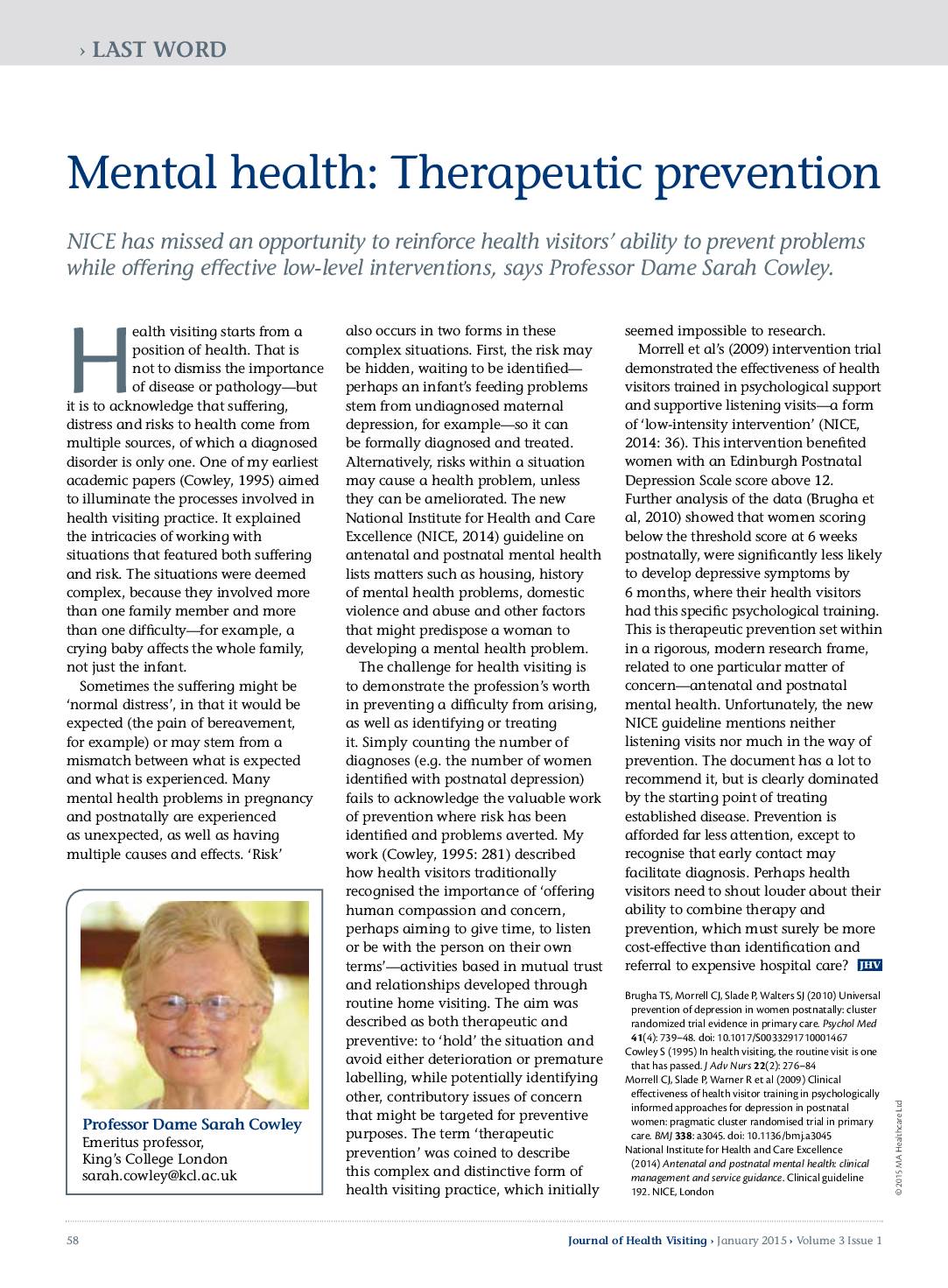
Mental health: Therapeutic prevention Journal Article
In: Journal of Health Visiting, vol. 3, no. 1, pp. 58–58, 2015, ISSN: 2050-8719, (Publisher: Mark Allen Group).
Abstract | Links | BibTeX | Tags:
@article{Cowley2015g,

title = {Mental health: Therapeutic prevention},

author = {Dame Sarah Cowley},

doi = {10.12968/johv.2015.3.1.58},

issn = {2050-8719},

year  = {2015},

date = {2015-01-01},

urldate = {2015-01-01},

journal = {Journal of Health Visiting},

volume = {3},

number = {1},

pages = {58–58},

abstract = {NICE has missed an opportunity to reinforce health visitors’ ability to prevent problems while offering effective low-level interventions, says Professor Dame Sarah Cowley.},

note = {Publisher: Mark Allen Group},

keywords = {},

pubstate = {published},

tppubtype = {article}

}
2014
Cowley, Dame Sarah
Prioritising impact areas Journal Article
In: Journal of Health Visiting, vol. 2, no. 10, pp. 576–576, 2014, ISSN: 2050-8719, (Publisher: Mark Allen Group).
Abstract | Links | BibTeX | Tags:
@article{Cowley2014,

title = {Prioritising impact areas},

author = {Dame Sarah Cowley},

url = {https://www.magonlinelibrary.com/doi/abs/10.12968/johv.2014.2.10.576},

doi = {10.12968/johv.2014.2.10.576},

issn = {2050-8719},

year  = {2014},

date = {2014-10-01},

urldate = {2014-10-01},

journal = {Journal of Health Visiting},

volume = {2},

number = {10},

pages = {576–576},

abstract = {The priority impact areas launched by the Department of Health provide a clear opportunity to demonstrate health visitors’ worth, says Professor Dame Sarah Cowley.},

note = {Publisher: Mark Allen Group},

keywords = {},

pubstate = {published},

tppubtype = {article}

}
Cowley, Dame Sarah
Health visiting: Profession or job? Journal Article
In: Journal of Health Visiting, vol. 2, no. 7, pp. 404–404, 2014, ISSN: 2050-8719, (Publisher: Mark Allen Group).
Abstract | Links | BibTeX | Tags:
@article{Cowley2014b,

title = {Health visiting: Profession or job?},

author = {Dame Sarah Cowley},

doi = {10.12968/johv.2014.2.7.404},

issn = {2050-8719},

year  = {2014},

date = {2014-07-01},

urldate = {2014-07-01},

journal = {Journal of Health Visiting},

volume = {2},

number = {7},

pages = {404–404},

abstract = {Unless health visiting is considered a profession, rather than just a job for nurses, any semblance of regulation by NMC may disappear, warns Professor Dame Sarah Cowley.},

note = {Publisher: Mark Allen Group},

keywords = {},

pubstate = {published},

tppubtype = {article}

}
Cowley, Dame Sarah
Changes in commissioning Journal Article
In: Journal of Health Visiting, vol. 2, no. 4, pp. 230–230, 2014, ISSN: 2050-8719, (Publisher: Mark Allen Group).
Abstract | Links | BibTeX | Tags:
@article{Cowley2014c,

title = {Changes in commissioning},

author = {Dame Sarah Cowley},

doi = {10.12968/johv.2014.2.4.230},

issn = {2050-8719},

year  = {2014},

date = {2014-04-01},

urldate = {2014-04-01},

journal = {Journal of Health Visiting},

volume = {2},

number = {4},

pages = {230–230},

abstract = {The move to local authority commissioning feels like a major culture change for health visiting, but there is potential for new opportunities, says Professor Dame Sarah Cowley.},

note = {Publisher: Mark Allen Group},

keywords = {},

pubstate = {published},

tppubtype = {article}

}
Cowley, Dame Sarah
Preparing new health visitors–time for change Journal Article
In: Journal of Health Visiting, vol. 2, no. 1, pp. 50, 2014.
BibTeX | Tags:
@article{Cowley2014d,

title = {Preparing new health visitors–time for change},

author = {Dame Sarah Cowley},

year  = {2014},

date = {2014-01-01},

urldate = {2014-01-01},

journal = {Journal of Health Visiting},

volume = {2},

number = {1},

pages = {50},

keywords = {},

pubstate = {published},

tppubtype = {article}

}
2013
Cowley, Dame Sarah
A new principle of universality? Journal Article
In: Journal of Health Visiting, vol. 1, no. 10, pp. 602–602, 2013, ISSN: 2050-8719, (Publisher: Mark Allen Group).
Abstract | Links | BibTeX | Tags:
@article{Cowley2013,

title = {A new principle of universality?},

author = {Dame Sarah Cowley},

doi = {10.12968/johv.2013.1.10.602},

issn = {2050-8719},

year  = {2013},

date = {2013-10-01},

urldate = {2013-10-01},

journal = {Journal of Health Visiting},

volume = {1},

number = {10},

pages = {602–602},

abstract = {For almost 40 years, health visitors have been guided by four principles. Professor Dame Sarah Cowley considers the value of adding ‘universality’ to the list.},

note = {Publisher: Mark Allen Group},

keywords = {},

pubstate = {published},

tppubtype = {article}

}
Cowley, Dame Sarah
Quality and safety in a preventive service: How could inspection help? Journal Article
In: Journal of Health Visiting, vol. 1, no. 7, pp. 422–422, 2013, ISSN: 2050-8719, (Publisher: Mark Allen Group).
Abstract | Links | BibTeX | Tags:
@article{Cowley2013b,

title = {Quality and safety in a preventive service: How could inspection help?},

author = {Dame Sarah Cowley},

doi = {10.12968/johv.2013.1.7.422},

issn = {2050-8719},

year  = {2013},

date = {2013-07-01},

urldate = {2013-07-01},

journal = {Journal of Health Visiting},

volume = {1},

number = {7},

pages = {422–422},

abstract = {The Care Quality Commission has proposed a new inspection scheme for health-care services. Dame Sarah Cowley considers how this might be applied to health visiting.},

note = {Publisher: Mark Allen Group},

keywords = {},

pubstate = {published},

tppubtype = {article}

}
Neill, Sarah J.; Cowley, Sarah; Williams, Clare
The role of felt or enacted criticism in understanding parent's help seeking in acute childhood illness at home: A grounded theory study Journal Article
In: International Journal of Nursing Studies, vol. 50, no. 6, pp. 757–767, 2013, ISSN: 0020-7489.
Abstract | Links | BibTeX | Tags: Acute childhood illness, Enacted criticism, Felt criticism, Grounded theory, Help-seeking behaviour, Parent
@article{Neill2013,

title = {The role of felt or enacted criticism in understanding parent's help seeking in acute childhood illness at home: A grounded theory study},

author = {Sarah J. Neill and Sarah Cowley and Clare Williams},

doi = {10.1016/j.ijnurstu.2011.11.007},

issn = {0020-7489},

year  = {2013},

date = {2013-06-01},

urldate = {2013-06-01},

journal = {International Journal of Nursing Studies},

volume = {50},

number = {6},

pages = {757–767},

series = {Child Health Care},

abstract = {Background


Parents with young children often worry about whether or not to seek medical help for a sick child. Previous research identified parents’ anxieties surrounding help seeking from health services but did not explore or explain the underlying psychosocial processes taking place in families at these times.


Objectives


This paper presents findings from a British grounded theory study on family management of acute childhood illness at home, which provide an explanation for parent's helping seeking behaviours.


Design


Glaserian grounded theory methodology was used for the study.


Setting


The sampling sites for the study were in two towns in the East Midlands with population profiles close to the national average for the UK.


Participants


Initial purposeful and later theoretical sampling resulted in a sample of fifteen families with children aged between 1 month and 8 years of age.


Methods


Four sets of data collection took place between 2001 and 2007. Unstructured family interviews were conducted with adult family members and a draw, write or tell technique was used to interview any children over 4 years of age. Theoretical sensitivity and constant comparative analysis were employed to achieve theoretical saturation around a core category.


Findings


Felt or enacted criticism teaches parents informal social rules which direct how they are expected to behave. Their desire to avoid such criticism of their moral status as ‘good’ parents creates significant hidden anxiety about when to seek medical help. This anxiety sometimes leads to late consultation with potentially serious consequences for their child's health.


Conclusion


The grounded theory indicates the need for significant investment in the training of nurses and other health professionals to reduce parents’ (and other patients’) experiences of felt or enacted criticism and the consequent hidden anxiety. When parents are worried about their child's health, they need to be able to seek help from health professionals without fear of criticism. These conclusions are primarily limited to universal health care environments.},

keywords = {Acute childhood illness, Enacted criticism, Felt criticism, Grounded theory, Help-seeking behaviour, Parent},

pubstate = {published},

tppubtype = {article}

}
Parents with young children often worry about whether or not to seek medical help for a sick child. Previous research identified parents’ anxieties surrounding help seeking from health services but did not explore or explain the underlying psychosocial processes taking place in families at these times.
Objectives
This paper presents findings from a British grounded theory study on family management of acute childhood illness at home, which provide an explanation for parent's helping seeking behaviours.
Design
Glaserian grounded theory methodology was used for the study.
Setting
The sampling sites for the study were in two towns in the East Midlands with population profiles close to the national average for the UK.
Participants
Initial purposeful and later theoretical sampling resulted in a sample of fifteen families with children aged between 1 month and 8 years of age.
Methods
Four sets of data collection took place between 2001 and 2007. Unstructured family interviews were conducted with adult family members and a draw, write or tell technique was used to interview any children over 4 years of age. Theoretical sensitivity and constant comparative analysis were employed to achieve theoretical saturation around a core category.
Findings
Felt or enacted criticism teaches parents informal social rules which direct how they are expected to behave. Their desire to avoid such criticism of their moral status as ‘good’ parents creates significant hidden anxiety about when to seek medical help. This anxiety sometimes leads to late consultation with potentially serious consequences for their child's health.
Conclusion
The grounded theory indicates the need for significant investment in the training of nurses and other health professionals to reduce parents’ (and other patients’) experiences of felt or enacted criticism and the consequent hidden anxiety. When parents are worried about their child's health, they need to be able to seek help from health professionals without fear of criticism. These conclusions are primarily limited to universal health care environments.
Cowley, Dame Sarah
Identifying outcomes relevant to health visiting services Journal Article
In: Journal of Health Visiting, vol. 1, no. 4, pp. 236–241, 2013, ISSN: 2050-8719, (Publisher: Mark Allen Group).
Abstract | Links | BibTeX | Tags:
@article{Cowley2013c,

title = {Identifying outcomes relevant to health visiting services},

author = {Dame Sarah Cowley},

doi = {10.12968/johv.2013.1.4.236},

issn = {2050-8719},

year  = {2013},

date = {2013-04-01},

urldate = {2013-04-01},

journal = {Journal of Health Visiting},

volume = {1},

number = {4},

pages = {236–241},

abstract = {The need to articulate and identify outcomes from health visiting services has been recognized for many years. Early challenges about underlying theory and suitable research methods are beginning to be overcome. Sarah Cowley explains the linear process that helps to identify evidence-based practice and outcomes for targeted prevention.},

note = {Publisher: Mark Allen Group},

keywords = {},

pubstate = {published},

tppubtype = {article}

}
Cowley, Dame Sarah
Presentation of (health visiting) self in everyday practice Journal Article
In: Journal of Health Visiting, vol. 1, no. 4, pp. 248–248, 2013, ISSN: 2050-8719, (Publisher: Mark Allen Group).
Abstract | Links | BibTeX | Tags:
@article{Cowley2013d,

title = {Presentation of (health visiting) self in everyday practice},

author = {Dame Sarah Cowley},

doi = {10.12968/johv.2013.1.4.248},

issn = {2050-8719},

year  = {2013},

date = {2013-04-01},

urldate = {2013-04-01},

journal = {Journal of Health Visiting},

volume = {1},

number = {4},

pages = {248–248},

abstract = {Some organisations are beginning to introduce uniforms for health visitors, but a key health visiting attribute is presentation of self. Sarah Cowley discusses the challenges of changes that are introduced by people who may not fully understand the health visiting service.},

note = {Publisher: Mark Allen Group},

keywords = {},

pubstate = {published},

tppubtype = {article}

}
McDonald, Anne; Frazer, Kate; Cowley, Dame Sarah
Caseload management: an approach to making community needs visible Journal Article
In: British Journal of Community Nursing, vol. 18, no. 3, pp. 140–147, 2013, ISSN: 1462-4753.
Abstract | Links | BibTeX | Tags: 80 and over, Adult, Aged, Case Management, Community Health Nursing, Data Collection, Documentation, Health Care Rationing, Health Services Research, Humans, Ireland, Middle Aged, needs assessment, Registries, Reproducibility of Results, Software Design, Workload
@article{McDonald2013,

title = {Caseload management: an approach to making community needs visible},

author = {Anne McDonald and Kate Frazer and Dame Sarah Cowley},

doi = {10.12968/bjcn.2013.18.3.140},

issn = {1462-4753},

year  = {2013},

date = {2013-03-01},

urldate = {2013-03-01},

journal = {British Journal of Community Nursing},

volume = {18},

number = {3},

pages = {140–147},

abstract = {AIM: To explore the process employed in the development of a population health framework and documentation for managing community nursing caseloads.


BACKGROUND: No formal structure exists to validate and link local health information collected by Irish public health nurses to a wider epidemiological framework. Neglect of this bottom up information forfeits opportunities to resource and manage public health nursing services.


DESIGN: Action research methods guided the development of the framework in one geographic area in Dublin and 34 participants engaged in Stringer's (1996) Look, Think and Act cycle.


RESULTS: The framework identified four patient registers: family health, chronic sick/disability, older adults and acute care, which identify public health outcomes for discussion within the caseload analysis process and can predict risk factors in local populations.


CONCLUSIONS: The use of the developed documentation identified a framework that describes caseloads in primary care and provides nurse managers with an evidence base to allocate resources, match skill mix to need, and estimate future workforce requirements.},

keywords = {80 and over, Adult, Aged, Case Management, Community Health Nursing, Data Collection, Documentation, Health Care Rationing, Health Services Research, Humans, Ireland, Middle Aged, needs assessment, Registries, Reproducibility of Results, Software Design, Workload},

pubstate = {published},

tppubtype = {article}

}
BACKGROUND: No formal structure exists to validate and link local health information collected by Irish public health nurses to a wider epidemiological framework. Neglect of this bottom up information forfeits opportunities to resource and manage public health nursing services.
DESIGN: Action research methods guided the development of the framework in one geographic area in Dublin and 34 participants engaged in Stringer's (1996) Look, Think and Act cycle.
RESULTS: The framework identified four patient registers: family health, chronic sick/disability, older adults and acute care, which identify public health outcomes for discussion within the caseload analysis process and can predict risk factors in local populations.
CONCLUSIONS: The use of the developed documentation identified a framework that describes caseloads in primary care and provides nurse managers with an evidence base to allocate resources, match skill mix to need, and estimate future workforce requirements.
Cowley, Sarah
Developing a coherent body of knowledge for health visiting Journal Article
In: Journal of Health Visiting, vol. 1, no. 1, pp. 66–66, 2013, ISSN: 2050-8719, (Publisher: Mark Allen Group).
Abstract | Links | BibTeX | Tags:
@article{cowley_developing_2013,

title = {Developing a coherent body of knowledge for health visiting},

author = {Sarah Cowley},

doi = {10.12968/johv.2013.1.1.66},

issn = {2050-8719},

year  = {2013},

date = {2013-01-01},

urldate = {2013-01-01},

journal = {Journal of Health Visiting},

volume = {1},

number = {1},

pages = {66–66},

abstract = {The field of knowledge for health visiting has experienced exponential growth and dramatic developments in the past few years. Professor Dame Sarah Cowley highlights the importance of collating this research to build and develop a coherent body of knowledge.},

note = {Publisher: Mark Allen Group},

keywords = {},

pubstate = {published},

tppubtype = {article}

}
2012
Whittaker, Karen A; Cowley, Sarah
A survey of parental self-efficacy experiences: maximising potential through health visiting and universal parenting support Journal Article
In: Journal of clinical nursing, vol. 21, no. 21-22, pp. 3276–3286, 2012, ISSN: 1365-2702.
Abstract | Links | BibTeX | Tags:
@article{whittaker_survey_2012,

title = {A survey of parental self-efficacy experiences: maximising potential through health visiting and universal parenting support},

author = {Karen A Whittaker and Sarah Cowley},

doi = {10.1111/j.1365-2702.2012.04074.x},

issn = {1365-2702},

year  = {2012},

date = {2012-11-01},

urldate = {2012-11-01},

journal = {Journal of clinical nursing},

volume = {21},

number = {21-22},

pages = {3276–3286},

abstract = {Aims and objectives


To examine parental self-efficacy experiences for users of a parenting support programme and consider the pertinence of self-efficacy theory to health visiting (public health nursing) practice.


Background


Commonly, successful parenting training programmes are underpinned by social learning principles and aim to strengthen parental self-efficacy. However, research examining programme effectiveness rarely discusses how self-efficacy outcomes are achieved.


Design


A descriptive survey was completed as the first part of a realistic evaluation study examining how a UK parenting support programme worked.


Methods


The first part of the realistic evaluation involved validating outcome measures (the Parenting Self-Agency Measure and Self-Efficacy for Parenting Tasks Index subscales) and administering a questionnaire survey. The questionnaire was completed by adults accessing a parenting support programme during a 10-month period (n = 168). Data were analysed using descriptive and inferential statistics.


Results


Women were the main users of the programme, which included informal drop-in groups as well as more formalised health visiting services and parenting training courses. The Parenting Self-Agency Measure results indicated good general parental self-efficacy; however, the task-specific Self-Efficacy for Parenting Tasks Indexes scales suggested that parents were less self-efficacious in disciplining children. Lower self-efficacy scores correlated with high ratings for 'feeling tired', 'receiving negative comments' and 'giving-in to a child's demands'.


Conclusions


Study results indicate that the domain general and task-specific measures provide different, but helpful, insights into parental self-efficacy experiences. By identifying factors associated with the levels of general and task-specific parental self-efficacy, health visitors can gain a fuller appreciation of support needs.Relevance to practiceTo maximise potential through parenting support, attention should be given to addressing factors associated with poorer self-efficacy experiences, including parental tiredness. Equally, practice should be directed at developing community environments that offer exposure to positive praise and the opportunity to practice new skills without facing criticism.},

keywords = {},

pubstate = {published},

tppubtype = {article}

}
To examine parental self-efficacy experiences for users of a parenting support programme and consider the pertinence of self-efficacy theory to health visiting (public health nursing) practice.
Background
Commonly, successful parenting training programmes are underpinned by social learning principles and aim to strengthen parental self-efficacy. However, research examining programme effectiveness rarely discusses how self-efficacy outcomes are achieved.
Design
A descriptive survey was completed as the first part of a realistic evaluation study examining how a UK parenting support programme worked.
Methods
The first part of the realistic evaluation involved validating outcome measures (the Parenting Self-Agency Measure and Self-Efficacy for Parenting Tasks Index subscales) and administering a questionnaire survey. The questionnaire was completed by adults accessing a parenting support programme during a 10-month period (n = 168). Data were analysed using descriptive and inferential statistics.
Results
Women were the main users of the programme, which included informal drop-in groups as well as more formalised health visiting services and parenting training courses. The Parenting Self-Agency Measure results indicated good general parental self-efficacy; however, the task-specific Self-Efficacy for Parenting Tasks Indexes scales suggested that parents were less self-efficacious in disciplining children. Lower self-efficacy scores correlated with high ratings for 'feeling tired', 'receiving negative comments' and 'giving-in to a child's demands'.
Conclusions
Study results indicate that the domain general and task-specific measures provide different, but helpful, insights into parental self-efficacy experiences. By identifying factors associated with the levels of general and task-specific parental self-efficacy, health visitors can gain a fuller appreciation of support needs.Relevance to practiceTo maximise potential through parenting support, attention should be given to addressing factors associated with poorer self-efficacy experiences, including parental tiredness. Equally, practice should be directed at developing community environments that offer exposure to positive praise and the opportunity to practice new skills without facing criticism.
Cowley, Sarah; Kemp, Lynn; Day, Crispin; Appleton, Jane
Research and the organisation of complex provision: conceptualising health visiting services and early years programmes Journal Article
In: Journal of Research in Nursing, vol. 17, no. 2, pp. 108–124, 2012, ISSN: 1744-9871, (Publisher: SAGE Publications Ltd).
Abstract | Links | BibTeX | Tags:
@article{cowley_research_2012,

title = {Research and the organisation of complex provision: conceptualising health visiting services and early years programmes},

author = {Sarah Cowley and Lynn Kemp and Crispin Day and Jane Appleton},

doi = {10.1177/1744987111430606},

issn = {1744-9871},

year  = {2012},

date = {2012-03-01},

urldate = {2012-03-01},

journal = {Journal of Research in Nursing},

volume = {17},

number = {2},

pages = {108–124},

abstract = {This paper developed from discussions about the possible implementation and trial of an Australian maternal and early childhood sustained home visiting programme (MECSH), into a United Kingdom (UK) context.


There are many similarities in services in the two countries, but some differences. To summarise and illustrate the complex and interconnected way that early years and preventive health services are specified, a diagram was developed, which provides a framework for this paper. The paper describes a health visiting service that encompasses universal, indicated and selective forms of prevention, with some embedded evidence-based programmes, forming part of a proactive and preventive service that is, itself, embedded within a wider resource system. Policy-driven terms derived from the English Health Visitor Implementation Plan have been used, but translated into the generic language of prevention (universal, indicated and selective), as a basis for future research. The place for different types of practitioner and needs of families with different levels of personal capacity or resource are also considered.


Increased understanding about how social determinants affect the whole population across a gradient has drawn attention to the need for more universal prevention, to tackle health inequalities. The components of successful early intervention programmes are well established, but more information is needed to support universal preventive services, which are delivered in a way that is proportionate to need.


This paper, including the diagram that summarises its contents, is presented to stimulate discussion as well as guide future research and service development.},

note = {Publisher: SAGE Publications Ltd},

keywords = {},

pubstate = {published},

tppubtype = {article}

}
There are many similarities in services in the two countries, but some differences. To summarise and illustrate the complex and interconnected way that early years and preventive health services are specified, a diagram was developed, which provides a framework for this paper. The paper describes a health visiting service that encompasses universal, indicated and selective forms of prevention, with some embedded evidence-based programmes, forming part of a proactive and preventive service that is, itself, embedded within a wider resource system. Policy-driven terms derived from the English Health Visitor Implementation Plan have been used, but translated into the generic language of prevention (universal, indicated and selective), as a basis for future research. The place for different types of practitioner and needs of families with different levels of personal capacity or resource are also considered.
Increased understanding about how social determinants affect the whole population across a gradient has drawn attention to the need for more universal prevention, to tackle health inequalities. The components of successful early intervention programmes are well established, but more information is needed to support universal preventive services, which are delivered in a way that is proportionate to need.
This paper, including the diagram that summarises its contents, is presented to stimulate discussion as well as guide future research and service development.
Whittaker, Karen A.; Cowley, Sarah
An effective programme is not enough: a review of factors associated with poor attendance and engagement with parenting support programmes Journal Article
In: Children & Society, vol. 2, no. 26, pp. 138–149, 2012, ISSN: 0951-0605, 1099-0860.
Abstract | Links | BibTeX | Tags:
@article{whittaker_effective_2012,

title = {An effective programme is not enough: a review of factors associated with poor attendance and engagement with parenting support programmes},

author = {Karen A. Whittaker and Sarah Cowley},

doi = {10.1111/j.1099-0860.2010.00333.x},

issn = {0951-0605, 1099-0860},

year  = {2012},

date = {2012-02-01},

urldate = {2012-02-01},

journal = {Children & Society},

volume = {2},

number = {26},

pages = {138–149},

abstract = {The provision of parenting support is a key feature of wealthier nations’ health and social care services. However, attendance and engagement by the neediest parents remains poor. Barriers experienced by parents include personal life factors (beliefs, lifestyles and limited resources) and programme‐specific factors (delivery, content and support arrangements). Here we give consideration to these issues, drawing on published reviews of parenting programme effectiveness identified through a comprehensive search of electronic databases. We suggest ways of improving attendance and engagement, by providing programmes as part of a comprehensive framework of family support.},

keywords = {},

pubstate = {published},

tppubtype = {article}

}
2011
Cowley, Sarah
Home visitors and child health in England: advances and challenges Journal Article
In: Revista da Escola de Enfermagem da U S P, vol. 45 Spec No 2, pp. 1810–1816, 2011, ISSN: 1980-220X.
Abstract | Links | BibTeX | Tags:
@article{cowley_home_2011,

title = {Home visitors and child health in England: advances and challenges},

author = {Sarah Cowley},

doi = {10.1590/s0080-62342011000800030},

issn = {1980-220X},

year  = {2011},

date = {2011-12-01},

urldate = {2011-12-01},

journal = {Revista da Escola de Enfermagem da U S P},

volume = {45 Spec No 2},

pages = {1810–1816},

abstract = {There is increasing interest in the early years as a focus for reducing health inequalities as well as one that is important for the children themselves. This paper describes the introduction in England of Sure Start Local Programmes, which included home visiting within a community development approach, and an intensive home visiting programme, the Nurse-Family partnership, for disadvantaged teenage mothers. It reflects on changes and challenges in service provision to mothers and their pre-school children in England, explaining that a long tradition of home visiting was, paradoxically, reduced as attention focused on the newer initiatives. This is now being addressed, with attention to a range of evidence based programmes and a specific focus on heath visitor provision.},

keywords = {},

pubstate = {published},

tppubtype = {article}

}
Portillo, Mari Carmen; Cowley, Sarah
Working the way up in neurological rehabilitation: the holistic approach of nursing care Journal Article
In: Journal of Clinical Nursing, vol. 20, no. 11‐12, pp. 1731–1743, 2011, (Publisher: John Wiley & Sons).
@article{portillo_working_2011,

title = {Working the way up in neurological rehabilitation: the holistic approach of nursing care},

author = {Mari Carmen Portillo and Sarah Cowley},

year  = {2011},

date = {2011-01-01},

urldate = {2011-01-01},

journal = {Journal of Clinical Nursing},

volume = {20},

number = {11‐12},

pages = {1731–1743},

abstract = {Aim


To provide understanding of the nurses’ role in neurological holistic rehabilitation and identify strategies for the enhancement of rehabilitation services.


Background


Although acute and chronic neurological patients and relatives experience emotional and social changes, most rehabilitation programmes do not deal with non‐physical needs or involve nurses, leading to a poor definition and specialisation of the nursing role.


Design


Action research.


Method


The project took place in two neurological wards of a highly specialised hospital in Spain and lasted 30 months. An individualised nurse‐led social rehabilitation programme was planned, implemented and evaluated. The nursing role and care in rehabilitation were explored with 37 nurses and 40 neurological patients and 40 relatives (convenience sampling). Semi‐structured interviews and participant observations were developed.


Content (QSR NUDIST Vivo v.2.0) and statistical (SPSS v. 13.0) analyses were run.


Results.


The lack of time, knowledge and experience, the poor definition of the nursing role and ineffective communication with users limited holistic care in the wards. Some enhancing nursing strategies were proposed and explored: promotion of acceptance/adaptation of the disease through education, reinforcement of the discharge planning and planning of emotional and social choices based on the assessment of individual needs and resources at home.


Conclusions


Nursing professionals are in a privileged position to deal with neurological patients’ and carers’ holistic needs. Several attributes of the advanced nursing role in rehabilitation teams have been proposed to deal with non‐physical aspects of care.


Relevance to clinical practice.

• Rehabilitation needs of neurological patients and carers at hospital have been described.

• Nurses’ perceptions of their work and role in rehabilitation have been presented.

• Clinical strategies to develop the advanced nursing role in holistic neurological rehabilitation have been highlighted.},

note = {Publisher: John Wiley & Sons},

keywords = {},

pubstate = {published},

tppubtype = {article}

}
To provide understanding of the nurses’ role in neurological holistic rehabilitation and identify strategies for the enhancement of rehabilitation services.
Background
Although acute and chronic neurological patients and relatives experience emotional and social changes, most rehabilitation programmes do not deal with non‐physical needs or involve nurses, leading to a poor definition and specialisation of the nursing role.
Design
Action research.
Method
The project took place in two neurological wards of a highly specialised hospital in Spain and lasted 30 months. An individualised nurse‐led social rehabilitation programme was planned, implemented and evaluated. The nursing role and care in rehabilitation were explored with 37 nurses and 40 neurological patients and 40 relatives (convenience sampling). Semi‐structured interviews and participant observations were developed.
Content (QSR NUDIST Vivo v.2.0) and statistical (SPSS v. 13.0) analyses were run.
Results.
The lack of time, knowledge and experience, the poor definition of the nursing role and ineffective communication with users limited holistic care in the wards. Some enhancing nursing strategies were proposed and explored: promotion of acceptance/adaptation of the disease through education, reinforcement of the discharge planning and planning of emotional and social choices based on the assessment of individual needs and resources at home.
Conclusions
Nursing professionals are in a privileged position to deal with neurological patients’ and carers’ holistic needs. Several attributes of the advanced nursing role in rehabilitation teams have been proposed to deal with non‐physical aspects of care.
Relevance to clinical practice.
• Rehabilitation needs of neurological patients and carers at hospital have been described.
• Nurses’ perceptions of their work and role in rehabilitation have been presented.
• Clinical strategies to develop the advanced nursing role in holistic neurological rehabilitation have been highlighted.
Portillo, Mari Carmen; Cowley, Sarah
Social rehabilitation in long-term conditions: learning about the process Journal Article
In: Journal of Advanced Nursing, vol. 67, no. 6, pp. 1329–1340, 2011, ISSN: 1365-2648.
Abstract | Links | BibTeX | Tags: healthcare domain, long-term conditions, nursing, social problem, Social rehabilitation, socialization
@article{portillo_social_2011,

title = {Social rehabilitation in long-term conditions: learning about the process},

author = {Mari Carmen Portillo and Sarah Cowley},

doi = {10.1111/j.1365-2648.2010.05600.x},

issn = {1365-2648},

year  = {2011},

date = {2011-01-01},

urldate = {2011-01-01},

journal = {Journal of Advanced Nursing},

volume = {67},

number = {6},

pages = {1329–1340},

abstract = {Aim


This paper is a report of a study of the process of social rehabilitation, and the analysis of the main elements and influencing factors which are important in the process.


Background


The process of social rehabilitation lacks conceptual and empirical understanding in Neurology because most rehabilitation programmes have focused on cognitive and physical recovery.


Methods


An action research project was undertaken in two neurological wards of a highly specialized hospital in Spain, and was completed in 2006. A social rehabilitation programme based on the assessment of social needs and individualized social education was planned with health professionals, and implemented and evaluated with patients and carers. Several instruments were used to explore how patients and carers perceived the process of social rehabilitation before and after the programme: semi-structured interviews, socio-demographic forms, field notes, participant observations, and scales of activities of daily living, social impairment and adjustment. Comparative content and statistical analyses were undertaken.


Findings


Social rehabilitation was identified as a dynamic process in which the environment, activities, social interaction, self-recognition and awareness of social problems, coping and satisfaction played an essential role. Some defining criteria for social rehabilitation related to patients’ and carers’ attitudes, behaviour and the external implications that the socialization process had for them.


Conclusion


This study shows the advantages of multidisciplinary work, and user and family involvement in social rehabilitation and provides in-depth knowledge about how patients and carers experience and could face barriers to develop a role in their family environment, social groups and society.},

keywords = {healthcare domain, long-term conditions, nursing, social problem, Social rehabilitation, socialization},

pubstate = {published},

tppubtype = {article}

}
This paper is a report of a study of the process of social rehabilitation, and the analysis of the main elements and influencing factors which are important in the process.
Background
The process of social rehabilitation lacks conceptual and empirical understanding in Neurology because most rehabilitation programmes have focused on cognitive and physical recovery.
Methods
An action research project was undertaken in two neurological wards of a highly specialized hospital in Spain, and was completed in 2006. A social rehabilitation programme based on the assessment of social needs and individualized social education was planned with health professionals, and implemented and evaluated with patients and carers. Several instruments were used to explore how patients and carers perceived the process of social rehabilitation before and after the programme: semi-structured interviews, socio-demographic forms, field notes, participant observations, and scales of activities of daily living, social impairment and adjustment. Comparative content and statistical analyses were undertaken.
Findings
Social rehabilitation was identified as a dynamic process in which the environment, activities, social interaction, self-recognition and awareness of social problems, coping and satisfaction played an essential role. Some defining criteria for social rehabilitation related to patients’ and carers’ attitudes, behaviour and the external implications that the socialization process had for them.
Conclusion
This study shows the advantages of multidisciplinary work, and user and family involvement in social rehabilitation and provides in-depth knowledge about how patients and carers experience and could face barriers to develop a role in their family environment, social groups and society.
Taylor, Claire; Richardson, Alison; Cowley, Sarah
In: European Journal of Oncology Nursing, vol. 15, no. 3, pp. 243–249, 2011, ISSN: 1462-3889, (Number: 3).
Abstract | Links | BibTeX | Tags:
@article{taylor_surviving_2011,

title = {Surviving cancer treatment: An investigation of the experience of fear about, and monitoring for, recurrence in patients following treatment for colorectal cancer},

author = {Claire Taylor and Alison Richardson and Sarah Cowley},

doi = {10.1016/j.ejon.2011.03.010},

issn = {1462-3889},

year  = {2011},

date = {2011-01-01},

urldate = {2011-01-01},

journal = {European Journal of Oncology Nursing},

volume = {15},

number = {3},

pages = {243–249},

abstract = {Background


It is known that many individuals worry about their cancer recurring after colorectal cancer treatment but the significance and specific manifestations of this problem require exploration.<br/><br/>Purpose<br/>This paper reports upon the research findings of a qualitative study to explain how fears of recurrence can affect individuals recovering from curative colorectal cancer surgery.


Methods


A longitudinal, grounded theory study was conducted. Sixteen participants who had received curative treatment for colorectal cancer were interviewed on up to four occasions during the 12 months following their surgery, 62 interviews were conducted in total.


Results


Many participants expressed anxiety about if and when their cancer might return, despite the knowledge that they had had successful treatment for early-stage colorectal cancer. This fear led some to adopt new behaviours in a desire to achieve a more dependable and controllable body. Heightened monitoring and management of the body characterised a state of ‘guarding’ – a concept developed from the data. By contrast, other participants did not perceive the risk of cancer recurrence to be as personally threatening or were able to assume strategies to manage any such concerns and find a sense of resolution to their recovery.


Conclusion


The nature of an individual’s response to fears of recurrence and consequent impact on their recovery warrants greater clinical consideration. Providing opportunities to openly discuss the possibility of cancer recurrence, assessing individual fears and offering suggestions on possible coping strategies to lessen the associated distress, are essential supportive activities enabling transition to life beyond cancer.},

note = {Number: 3},

keywords = {},

pubstate = {published},

tppubtype = {article}

}
It is known that many individuals worry about their cancer recurring after colorectal cancer treatment but the significance and specific manifestations of this problem require exploration.<br/><br/>Purpose<br/>This paper reports upon the research findings of a qualitative study to explain how fears of recurrence can affect individuals recovering from curative colorectal cancer surgery.
Methods
A longitudinal, grounded theory study was conducted. Sixteen participants who had received curative treatment for colorectal cancer were interviewed on up to four occasions during the 12 months following their surgery, 62 interviews were conducted in total.
Results
Many participants expressed anxiety about if and when their cancer might return, despite the knowledge that they had had successful treatment for early-stage colorectal cancer. This fear led some to adopt new behaviours in a desire to achieve a more dependable and controllable body. Heightened monitoring and management of the body characterised a state of ‘guarding’ – a concept developed from the data. By contrast, other participants did not perceive the risk of cancer recurrence to be as personally threatening or were able to assume strategies to manage any such concerns and find a sense of resolution to their recovery.
Conclusion
The nature of an individual’s response to fears of recurrence and consequent impact on their recovery warrants greater clinical consideration. Providing opportunities to openly discuss the possibility of cancer recurrence, assessing individual fears and offering suggestions on possible coping strategies to lessen the associated distress, are essential supportive activities enabling transition to life beyond cancer.
2010
Cowley, Sarah
Happy returns: reflections on a further visit Journal Article
In: Revista da Escola de Enfermagem da USP, vol. 44, pp. 859–860, 2010, ISSN: 0080-6234, 1980-220X, (Publisher: Universidade de São Paulo, Escola de Enfermagem).
@article{cowley_happy_2010,

title = {Happy returns: reflections on a further visit},

author = {Sarah Cowley},

doi = {10.1590/S0080-62342010000400001},

issn = {0080-6234, 1980-220X},

year  = {2010},

date = {2010-12-01},

urldate = {2010-12-01},

journal = {Revista da Escola de Enfermagem da USP},

volume = {44},

pages = {859–860},

note = {Publisher: Universidade de São Paulo, Escola de Enfermagem},

keywords = {},

pubstate = {published},

tppubtype = {article}

}
Cowley, Sarah
Explaining the principles of health visiting in Brazil Journal Article
In: Community Practitioner: The Journal of the Community Practitioners' & Health Visitors' Association, vol. 83, no. 11, pp. 21–25, 2010, ISSN: 1462-2815.
Abstract | BibTeX | Tags: Brazil, Community Health Nursing, health promotion, Humans, Information Dissemination, Nurse's Role, Organizational Objectives, Social Change
@article{cowley_explaining_2010,

title = {Explaining the principles of health visiting in Brazil},

author = {Sarah Cowley},

issn = {1462-2815},

year  = {2010},

date = {2010-11-01},

urldate = {2010-11-01},

journal = {Community Practitioner: The Journal of the Community Practitioners' & Health Visitors' Association},

volume = {83},

number = {11},

pages = {21–25},

abstract = {Brazil is a rapidly developing country. Modern health services operate in a situation of extreme social change, which resembles some of the conditions that gave rise to health visiting in 19th century Britain. A visit there revealed much interest in the health visiting principles of the search for health needs, the stimulation of an awareness of health needs, the influence on policies affecting health and the facilitation of health-enhancing activities. Explaining these principles to an audience on the other side of the world highlighted three underlying themes.


The principles of health visiting are about health promotion, not assistance; they provide an integrated framework, not a list of competences or skills; and they are all underpinned by a particular value and view of health. The explanation was met with great interest. We need to be both more aware and better able to explain these underlying themes in this country as well.},

keywords = {Brazil, Community Health Nursing, health promotion, Humans, Information Dissemination, Nurse's Role, Organizational Objectives, Social Change},

pubstate = {published},

tppubtype = {article}

}
The principles of health visiting are about health promotion, not assistance; they provide an integrated framework, not a list of competences or skills; and they are all underpinned by a particular value and view of health. The explanation was met with great interest. We need to be both more aware and better able to explain these underlying themes in this country as well.
Taylor, Claire; Richardson, Alison; Cowley, Sarah
Restoring embodied control following surgical treatment for colorectal cancer: A longitudinal qualitative study Journal Article
In: International Journal of Nursing Studies, vol. 47, no. 8, pp. 946–956, 2010, ISSN: 0020-7489.
Abstract | Links | BibTeX | Tags: Colorectal cancer, Embodiment, Grounded theory, Recovery, Surgery, Survivorship
@article{taylor_restoring_2010,

title = {Restoring embodied control following surgical treatment for colorectal cancer: A longitudinal qualitative study},

author = {Claire Taylor and Alison Richardson and Sarah Cowley},

doi = {10.1016/j.ijnurstu.2009.12.008},

issn = {0020-7489},

year  = {2010},

date = {2010-08-01},

urldate = {2010-08-01},

journal = {International Journal of Nursing Studies},

volume = {47},

number = {8},

pages = {946–956},

abstract = {Background


This article presents the findings of a study about recovery following surgery for colorectal cancer. Most patients diagnosed with this cancer are treated with surgery. Few studies have employed a qualitative approach to examine their experiences and perceptions of recovering from this treatment.


Objectives


The purpose of this study was to discover the process of recovery for individuals following curative surgery for colorectal cancer.


Design


This qualitative study drew on grounded theory methods and used a prospective longitudinal design.

Settings

Ethical approval was granted by three Local Research Ethics Committees enabling patients to be recruited from three different hospitals in the South of England.


Participants


Purposive sampling was used to identify patients diagnosed with colorectal cancer who had had surgery with curative intent.


Methods


Each participant was interviewed up to four times following their surgery: at 6 weeks then at 3, 6 and 12 months. Sixty-two interviews were conducted. Emerging concepts from the analysis defined further data collection. Relevant literature was theoretically sampled and all data analysed using constant comparison. Theoretical saturation was achieved.


Results


Sixteen participants were recruited. Analysis of study data identified four conceptual stages representing the main phases individuals can experience during their recovery. They are: disembodiment, restoring embodiment, reclaiming control and managing embodied control. These occur in a stepwise progression, reflecting the emotional, physical and social processes involved in restoring perceived control over the body. They reflect the difficulty individuals can experience in understanding and self-managing their bodies. There is a desire to regain confidence and certainty over body function but this is threatened by fears about future health.


Conclusions


Achieving a sense of control of one's body, after surgery for colorectal cancer, proves to be a major challenge. Greater

recognition of the consequences of cancer and its treatment upon the body and individualised management is required. Addressing how individuals can regain embodied control during their recovery needs to be integral within post-treatment support.},

keywords = {Colorectal cancer, Embodiment, Grounded theory, Recovery, Surgery, Survivorship},

pubstate = {published},

tppubtype = {article}

}
This article presents the findings of a study about recovery following surgery for colorectal cancer. Most patients diagnosed with this cancer are treated with surgery. Few studies have employed a qualitative approach to examine their experiences and perceptions of recovering from this treatment.
Objectives
The purpose of this study was to discover the process of recovery for individuals following curative surgery for colorectal cancer.
Design
This qualitative study drew on grounded theory methods and used a prospective longitudinal design.
Settings
Ethical approval was granted by three Local Research Ethics Committees enabling patients to be recruited from three different hospitals in the South of England.
Participants
Purposive sampling was used to identify patients diagnosed with colorectal cancer who had had surgery with curative intent.
Methods
Each participant was interviewed up to four times following their surgery: at 6 weeks then at 3, 6 and 12 months. Sixty-two interviews were conducted. Emerging concepts from the analysis defined further data collection. Relevant literature was theoretically sampled and all data analysed using constant comparison. Theoretical saturation was achieved.
Results
Sixteen participants were recruited. Analysis of study data identified four conceptual stages representing the main phases individuals can experience during their recovery. They are: disembodiment, restoring embodiment, reclaiming control and managing embodied control. These occur in a stepwise progression, reflecting the emotional, physical and social processes involved in restoring perceived control over the body. They reflect the difficulty individuals can experience in understanding and self-managing their bodies. There is a desire to regain confidence and certainty over body function but this is threatened by fears about future health.
Conclusions
Achieving a sense of control of one's body, after surgery for colorectal cancer, proves to be a major challenge. Greater
recognition of the consequences of cancer and its treatment upon the body and individualised management is required. Addressing how individuals can regain embodied control during their recovery needs to be integral within post-treatment support.
Cowley, Sarah
In: Community Practitioner, vol. 83, no. 1, pp. 30–32, 2010, ISSN: 14622815, (Publisher: Ten Alps Publishing).
BibTeX | Tags:
@article{cowley_say_2010,

title = {Say 'health visiting': Unite is campaigning for health visiting's return to statute for proper professional regulation and clarity over titles, standards and conduct},

author = {Sarah Cowley},

issn = {14622815},

year  = {2010},

date = {2010-01-01},

urldate = {2010-01-01},

journal = {Community Practitioner},

volume = {83},

number = {1},

pages = {30–32},

note = {Publisher: Ten Alps Publishing},

keywords = {},

pubstate = {published},

tppubtype = {article}

}
2009
Cowley, Sarah; Bidmead, Christine
Controversial questions (part three): is there randomised controlled trial evidence for health visiting? Journal Article
In: Community Practitioner, vol. 82, no. 8, pp. 24–29, 2009, ISSN: 14622815, (Publisher: Ten Alps Publishing).
@article{cowley_controversial_2009-2,

title = {Controversial questions (part three): is there randomised controlled trial evidence for health visiting?},

author = {Sarah Cowley and Christine Bidmead},

issn = {14622815},

year  = {2009},

date = {2009-08-01},

urldate = {2009-08-01},

journal = {Community Practitioner},

volume = {82},

number = {8},

pages = {24–29},

abstract = {Questions are often asked by managers, commissioners and policy-makers to find out what is, or should be, happening within health visiting services. This is the final paper in a series of three that draws on the experience of providing evidence to the Health Select Committee's 2008 inquiry into health inequalities. Material submitted has been adapted and expanded according to three common, often controversial questions.


This paper considers the relevance and place of randomised controlled trials in relation to health visiting services. Increasingly, commissioners require that services and programmes that they fund to be supported by this form of evidence, and many ask, 'Is there a randomised controlled trial of health visiting?' The immediate answer to this question is 'no', but there is a wealth of evidence relevant to health visiting, much of it from experimental research and systematic reviews. The question itself is not appropriately framed, so three alternative questions are proposed that can help to guide a search for evidence that is relevant to health visiting.},

note = {Publisher: Ten Alps Publishing},

keywords = {},

pubstate = {published},

tppubtype = {article}

}
This paper considers the relevance and place of randomised controlled trials in relation to health visiting services. Increasingly, commissioners require that services and programmes that they fund to be supported by this form of evidence, and many ask, 'Is there a randomised controlled trial of health visiting?' The immediate answer to this question is 'no', but there is a wealth of evidence relevant to health visiting, much of it from experimental research and systematic reviews. The question itself is not appropriately framed, so three alternative questions are proposed that can help to guide a search for evidence that is relevant to health visiting.
Cowley, Sarah; Bidmead, Christine
Controversial questions (part two): should there be a direct-entry route to health visitor education? Journal Article
In: Community Practitioner: The Journal of the Community Practitioners' & Health Visitors' Association, vol. 82, no. 7, pp. 24–28, 2009, ISSN: 1462-2815.
Abstract | BibTeX | Tags: Baccalaureate, Community Health Nursing, Curriculum, Education, Forecasting, Graduate, Health Services Needs and Demand, Humans, Licensure, Nurse Clinicians, nursing, Personnel Selection, Retirement, School Admission Criteria, Time Factors, United Kingdom, Workforce
@article{cowley_controversial_2009-1,

title = {Controversial questions (part two): should there be a direct-entry route to health visitor education?},

author = {Sarah Cowley and Christine Bidmead},

issn = {1462-2815},

year  = {2009},

date = {2009-07-01},

urldate = {2009-07-01},

journal = {Community Practitioner: The Journal of the Community Practitioners' & Health Visitors' Association},

volume = {82},

number = {7},

pages = {24–28},

abstract = {This is the second paper in a series of three, drawing on the experience of providing evidence to the Health Select Committee's 2008 inquiry into health inequalities.


Material submitted has been adapted and expanded according to three common and often controversial questions. One member of the committee enquired about the relevance of education and training to recruitment issues in health visiting, asking why it is necessary to be a nurse and what would be the barriers to changing this arrangement, which has been in force since the 1960s.


This paper summarises some of the longstanding discussions about this issue, which has rarely been off the agenda, and proposes that, since health visiting is no longer in statute, the time has come to take a radical approach and to change current arrangements.},

keywords = {Baccalaureate, Community Health Nursing, Curriculum, Education, Forecasting, Graduate, Health Services Needs and Demand, Humans, Licensure, Nurse Clinicians, nursing, Personnel Selection, Retirement, School Admission Criteria, Time Factors, United Kingdom, Workforce},

pubstate = {published},

tppubtype = {article}

}
Material submitted has been adapted and expanded according to three common and often controversial questions. One member of the committee enquired about the relevance of education and training to recruitment issues in health visiting, asking why it is necessary to be a nurse and what would be the barriers to changing this arrangement, which has been in force since the 1960s.
This paper summarises some of the longstanding discussions about this issue, which has rarely been off the agenda, and proposes that, since health visiting is no longer in statute, the time has come to take a radical approach and to change current arrangements.
Cowley, Sarah; Bidmead, Christine
Controversial questions (part one): what is the right size for a health visiting caseload? Journal Article
In: Community Practitioner: The Journal of the Community Practitioners' & Health Visitors' Association, vol. 82, no. 6, pp. 18–22, 2009, ISSN: 1462-2815.
Abstract | BibTeX | Tags: Case Management, Child, Child Welfare, Community Health Nursing, England, Family Nursing, Female, Health Status Disparities, Humans, Infant, needs assessment, Newborn, Preschool, Vulnerable Populations, Workload
@article{cowley_controversial_2009,

title = {Controversial questions (part one): what is the right size for a health visiting caseload?},

author = {Sarah Cowley and Christine Bidmead},

issn = {1462-2815},

year  = {2009},

date = {2009-06-01},

urldate = {2009-06-01},

journal = {Community Practitioner: The Journal of the Community Practitioners' & Health Visitors' Association},

volume = {82},

number = {6},

pages = {18–22},

abstract = {Questions asked by managers, commissioners and policy makers to find out what is, or should be, happening within health visiting services can seem immensely helpful in focusing the mind or clarifying key points. Alternatively, they may feel hostile and accusative, if their starting assumptions are alien to the everyday experience of health visitors.


This paper is the first in a short series of three that draw on the experience of providing evidence to the Health Select Committee's 2008 inquiry into health inequalities. A formal process of seeking written evidence was followed up with specific questions in oral session, asked by committee members, trying to find out about how health visiting services relate to health inequalities. This line of questioning reflects concerns expressed elsewhere about the variability of health visiting services across the country and the lack of clear alignment to areas of deprivation, leading to calls for an increase in targeted services, instead of universal ones.


This paper explores the notion of 'caseload', the distribution of services according to levels of deprivation and delivery of a universal or targeted health visiting service.},

keywords = {Case Management, Child, Child Welfare, Community Health Nursing, England, Family Nursing, Female, Health Status Disparities, Humans, Infant, needs assessment, Newborn, Preschool, Vulnerable Populations, Workload},

pubstate = {published},

tppubtype = {article}

}
This paper is the first in a short series of three that draw on the experience of providing evidence to the Health Select Committee's 2008 inquiry into health inequalities. A formal process of seeking written evidence was followed up with specific questions in oral session, asked by committee members, trying to find out about how health visiting services relate to health inequalities. This line of questioning reflects concerns expressed elsewhere about the variability of health visiting services across the country and the lack of clear alignment to areas of deprivation, leading to calls for an increase in targeted services, instead of universal ones.
This paper explores the notion of 'caseload', the distribution of services according to levels of deprivation and delivery of a universal or targeted health visiting service.