
2013
Cowley, Sarah; Whittaker, Karen; Grigulis, Astrida; Malone, Mary; Donetto, Sara; Wood, Heather; Morrow, Elizabeth; Maben, Jill
Why health visiting? A review of the literature about key health visitor interventions, processes and outcomes for children and families Technical Report
National Nursing Research Unit, King’s College London. 2013.
@techreport{cowley_why_2013,

title = {Why health visiting? A review of the literature about key health visitor interventions, processes and outcomes for children and families},

author = {Sarah Cowley and Karen Whittaker and Astrida Grigulis and Mary Malone and Sara Donetto and Heather Wood and Elizabeth Morrow and Jill Maben},

year  = {2013},

date = {2013-02-01},

urldate = {2013-02-01},

institution = {National Nursing Research Unit, King’s College London.},

abstract = {Introduction


There is increasing international interest in universal, health promoting services for pregnancy and the first three years of life and the concept of proportionate universalism. Drawing on a narrative review of literature, this paper explores mechanisms by which such services might contribute to health improvement and reducing health inequalities.


Objectives


Through a narrative review of empirical literature, to identify:

(1) What are the key components of health visiting practice?

(2) How are they reflected in implementing the universal service/provision envisaged in the English Health Visitor Implementation Plan (HVIP)?


Design


The paper draws upon a scoping study and narrative review.


Review Methods


We used three complementary approaches to search the widely dispersed literature:

(1) broad, general search,

(2) structured search, using topic-specific search terms

(3) seminal paper search.


Our key inclusion criterion was information about health visiting practice. We included empirical papers from United Kingdom (UK) from 2004 to February 2012 and older seminal papers identified in search (3), identifying a total of 348 papers for inclusion. A thematic content analysis compared the older (up to 2003) with more recent research (2004 onwards).


Results


The analysis revealed health visiting practice as potentially characterized by a particular ‘orientation to practice.’ This embodied the values, skills and attitudes needed to deliver universal health visiting services through salutogenesis (health creation), person-centredness (human valuing) and viewing the person in situation (human ecology). Research about health visiting actions focuses on home visiting, needs assessment and parent-health visitor relationships. The detailed description of health visitors’ skills, attitudes, values, and their application in practice, provides an explanation of how universal provision can potentially help to promote health and shift the social gradient of health inequalities.


Conclusions


Identification of needs across an undifferentiated, universal caseload, combined with an outreach style that enhances uptake of needed services and appropriate health or parenting information, creates opportunities for parents who may otherwise have remained unaware of, or unwilling to engage with such provision.

There is a lack of evaluative research about health visiting practice, service organization or universal health visiting as potential mechanisms for promoting health and reducing health inequalities. This paper offers a potential foundation for such research in future.},

keywords = {},

pubstate = {published},

tppubtype = {techreport}

}
There is increasing international interest in universal, health promoting services for pregnancy and the first three years of life and the concept of proportionate universalism. Drawing on a narrative review of literature, this paper explores mechanisms by which such services might contribute to health improvement and reducing health inequalities.
Objectives
Through a narrative review of empirical literature, to identify:
(1) What are the key components of health visiting practice?
(2) How are they reflected in implementing the universal service/provision envisaged in the English Health Visitor Implementation Plan (HVIP)?
Design
The paper draws upon a scoping study and narrative review.
Review Methods
We used three complementary approaches to search the widely dispersed literature:
(1) broad, general search,
(2) structured search, using topic-specific search terms
(3) seminal paper search.
Our key inclusion criterion was information about health visiting practice. We included empirical papers from United Kingdom (UK) from 2004 to February 2012 and older seminal papers identified in search (3), identifying a total of 348 papers for inclusion. A thematic content analysis compared the older (up to 2003) with more recent research (2004 onwards).
Results
The analysis revealed health visiting practice as potentially characterized by a particular ‘orientation to practice.’ This embodied the values, skills and attitudes needed to deliver universal health visiting services through salutogenesis (health creation), person-centredness (human valuing) and viewing the person in situation (human ecology). Research about health visiting actions focuses on home visiting, needs assessment and parent-health visitor relationships. The detailed description of health visitors’ skills, attitudes, values, and their application in practice, provides an explanation of how universal provision can potentially help to promote health and shift the social gradient of health inequalities.
Conclusions
Identification of needs across an undifferentiated, universal caseload, combined with an outreach style that enhances uptake of needed services and appropriate health or parenting information, creates opportunities for parents who may otherwise have remained unaware of, or unwilling to engage with such provision.
There is a lack of evaluative research about health visiting practice, service organization or universal health visiting as potential mechanisms for promoting health and reducing health inequalities. This paper offers a potential foundation for such research in future.
Donetto, S; Malone, M; Hughes, J; Morrow, E; Cowley, S; Maben, J
National Nursing Research Unit, King’s College London. 2013.
BibTeX | Tags:
@techreport{donetto_health_2013,

title = {Health visiting: the voice of service users-Learning from service users’ experiences to inform the development of UK health visiting practice and services},

author = {S Donetto and M Malone and J Hughes and E Morrow and S Cowley and J Maben},

year  = {2013},

date = {2013-01-01},

urldate = {2013-01-01},

institution = {National Nursing Research Unit, King’s College London.},

keywords = {},

pubstate = {published},

tppubtype = {techreport}

}
Whittaker, Karen; Grigulis, Astrida; Hughes, Jane; Cowley, Sarah; Morrow, Elizabeth; Nicholson, Caroline; Malone, Mary; Maben, Jill
Start and stay: the recruitment and retention of health visitors Technical Report
National Nursing Research Unit, King’s College London. 2013.
BibTeX | Tags:
@techreport{whittaker_start_2013,

title = {Start and stay: the recruitment and retention of health visitors},

author = {Karen Whittaker and Astrida Grigulis and Jane Hughes and Sarah Cowley and Elizabeth Morrow and Caroline Nicholson and Mary Malone and Jill Maben},

year  = {2013},

date = {2013-01-01},

urldate = {2013-01-01},

institution = {National Nursing Research Unit, King’s College London.},

keywords = {},

pubstate = {published},

tppubtype = {techreport}

}
2011
Blewett, James; Hussein, Shereen; Tunstill, Jane; Manthorpe, Jill; Cowley, Sarah
Children’s Centres in 2011: Improving outcomes for the children who use Action for Children Children’s Centres Technical Report
King’s College London 2011, (Publisher: Action for Children).
BibTeX | Tags:
@techreport{blewett_childrens_2011,

title = {Children’s Centres in 2011: Improving outcomes for the children who use Action for Children Children’s Centres},

author = {James Blewett and Shereen Hussein and Jane Tunstill and Jill Manthorpe and Sarah Cowley},

year  = {2011},

date = {2011-01-01},

urldate = {2011-01-01},

institution = {King’s College London},

note = {Publisher: Action for Children},

keywords = {},

pubstate = {published},

tppubtype = {techreport}

}
2010
Cowley, Sarah A.
The role of Action for Children Children’s Centres in the local service system for children and their families Technical Report
2010.
@techreport{cowley_role_2010,

title = {The role of Action for Children Children’s Centres in the local service system for children and their families},

author = {Sarah A. Cowley},

year  = {2010},

date = {2010-01-01},

urldate = {2010-01-01},

abstract = {The project described in this interim report has been commissioned by Action for Children to address the need for timely feedback on the existing work of its Children’s Centres; and, as importantly, on their unique ability to meet the challenges outlined. The study design takes account of the specific goals set out by Action for Children, which it refers to as the five pillars, described fully in Action for Children’s strategic plan},

keywords = {},

pubstate = {published},

tppubtype = {techreport}

}
Cowley, Professor Sarah
Professional briefing: Public safety and statutory regulation of Health Visitors Technical Report
2010.
@techreport{nokey,

title = {Professional briefing:  Public safety and statutory regulation of Health Visitors},

author = {Professor Sarah Cowley },

year  = {2010},

date = {2010-01-01},

urldate = {2010-01-01},

pages = {40},

publisher = {Unite the Union},

organization = {Unite the Union/Community Practitioners’ and Health Visitors’ Association/},

abstract = {It is the contention of Unite/Community Practitioners’ and Health Visitors’ Association (CPHVA) that public safety has been compromised by changes in the statute governing health visitor regulation, enacted in the Nursing and Midwifery Order 2001. The Nursing & Midwifery Council are asked to explore how the anomalous position of health visiting as a profession, currently existing outside statute, can be regularised.},

keywords = {},

pubstate = {published},

tppubtype = {techreport}

}
2009
Cowley, Sarah; Rudgley, Denise
Health visiting matters: re-establishing health visiting Technical Report
2009.
@techreport{cowley_health_2009,

title = {Health visiting matters: re-establishing health visiting},

author = {Sarah Cowley and Denise Rudgley},

year  = {2009},

date = {2009-11-01},

urldate = {2009-11-01},

abstract = {2012 is not just Olympic year. It marks 150 years after the ‘Salford Ladies’ first employed a health visitor. In 2007 this struck a chord with many as the health visiting service was in major decline. That same year, the Family and Parenting Institute (FPI) published a report on declining health visitor numbers and a report of an independent Review of health visiting was also being formulated (Lowe 2007), which identified some of the barriers to delivering a universal health visiting service.


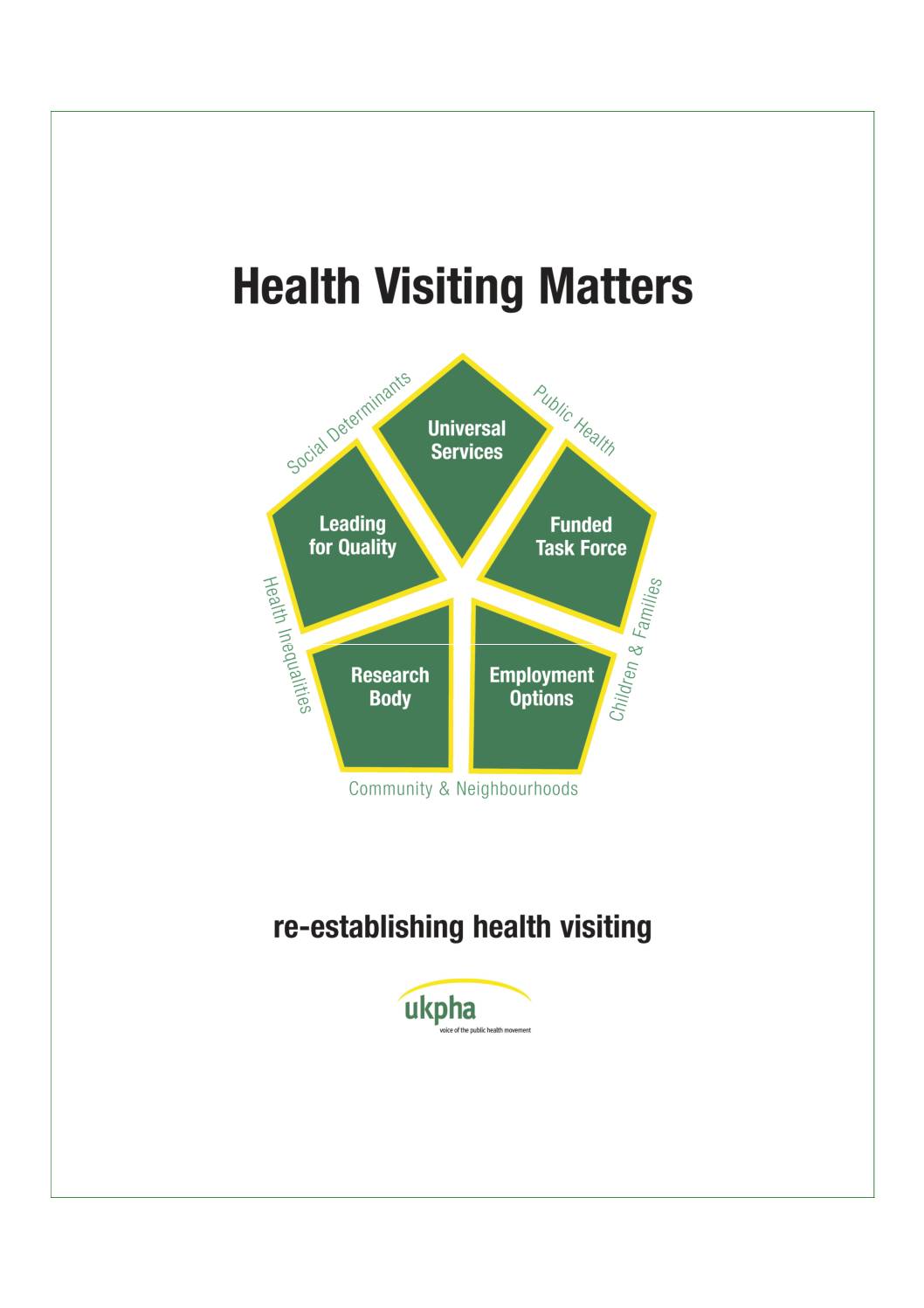
The UK Public Health Association’s (UKPHA’s) Special Interest Group (SIG) for Health Visiting and Public Health issued a response to this Review and, in honour of those first ‘Salford Ladies’, pushed for the momentum around the issue not to be lost. The UKPHA Health Visiting and Public Health SIG’s response to the health visiting Review identified the need for a specific regeneration project, focusing upon five broad areas of critical importance to ensuring a ‘fit for purpose’ health visiting service for the 21st Century. In October 2007 the UKPHA organised a symposium at Portcullis House which brought together key leaders, opinion formers and practitioners from across the country to begin the process of developing these five areas.


Taking its name from the title of a WHO Report published that same year, “A Powerful Equalizer: Regenerating The Health Visiting Profession”, the Symposium articulated the need for a Steering Group to be set up which would progress thinking and agree a way forward. As a result, a multi-agency Steering Group, coordinated by the UKPHA, developed a proposal seeking funding through a public health workforce development programme at the Department of Health to appoint a co-ordinator to bring working groups together to explore these issues, and agree recommendations about how best to deliver a regenerated health visiting service. A preliminary report was considered at a multiagency workshop, again planned and organised by the UKPHA, in September 2009 and the draft recommendations discussed and refined.


This, the final report was launched at the House of Commons at the end of November 2009 and is also available to download from www.ukpha.org.uk.},

keywords = {},

pubstate = {published},

tppubtype = {techreport}

}
The UK Public Health Association’s (UKPHA’s) Special Interest Group (SIG) for Health Visiting and Public Health issued a response to this Review and, in honour of those first ‘Salford Ladies’, pushed for the momentum around the issue not to be lost. The UKPHA Health Visiting and Public Health SIG’s response to the health visiting Review identified the need for a specific regeneration project, focusing upon five broad areas of critical importance to ensuring a ‘fit for purpose’ health visiting service for the 21st Century. In October 2007 the UKPHA organised a symposium at Portcullis House which brought together key leaders, opinion formers and practitioners from across the country to begin the process of developing these five areas.
Taking its name from the title of a WHO Report published that same year, “A Powerful Equalizer: Regenerating The Health Visiting Profession”, the Symposium articulated the need for a Steering Group to be set up which would progress thinking and agree a way forward. As a result, a multi-agency Steering Group, coordinated by the UKPHA, developed a proposal seeking funding through a public health workforce development programme at the Department of Health to appoint a co-ordinator to bring working groups together to explore these issues, and agree recommendations about how best to deliver a regenerated health visiting service. A preliminary report was considered at a multiagency workshop, again planned and organised by the UKPHA, in September 2009 and the draft recommendations discussed and refined.
This, the final report was launched at the House of Commons at the end of November 2009 and is also available to download from www.ukpha.org.uk.
2007
Memorandum by Professor Sarah Cowley (HI 76) The contribution of the NHS to reducing health inequalities. Technical Report
Health Committee House of Commons, no. HC 422-II, 2007.
BibTeX | Tags:
@techreport{cowley_memorandum_2007,

title = {Memorandum by Professor Sarah Cowley (HI 76) The contribution of the NHS to reducing health inequalities.},

year  = {2007},

date = {2007-01-01},

urldate = {2007-01-01},

number = {HC 422-II},

pages = {256–261},

address = {House of Commons},

institution = {Health Committee},

keywords = {},

pubstate = {published},

tppubtype = {techreport}

}
2002
Hean, S; Cowley, S; Forbes, A; Griffiths, P
An examination of the potential to Identify an instrument reflecting measurable attributes of social capital Technical Report
London Report to Health Development Agency. Florence Nightingale S, 2002.
BibTeX | Tags:
@techreport{hean_examination_2002,

title = {An examination of the potential to Identify an instrument reflecting measurable attributes of social capital},

author = {S Hean and S Cowley and A Forbes and P Griffiths},

year  = {2002},

date = {2002-01-01},

urldate = {2002-01-01},

address = {Report to Health Development Agency. Florence Nightingale S},

institution = {London},

keywords = {},

pubstate = {published},

tppubtype = {techreport}

}
2000
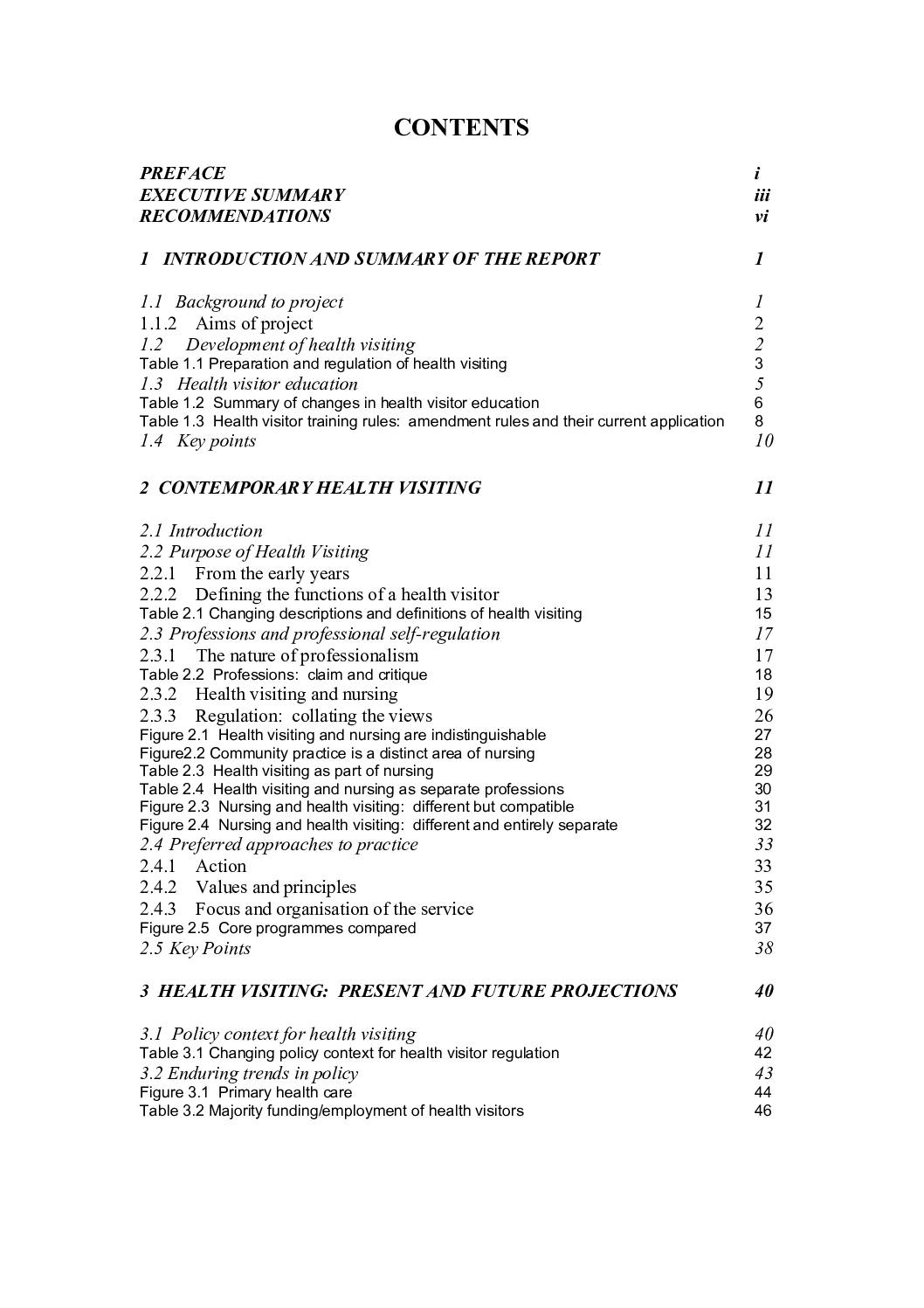
Cowley, Sarah; Buttigieg, Margaret; Houston, Anna
A first steps project to scope the current and future regulatory issues for health visiting Technical Report
UKCC 2000.
BibTeX | Tags:
@techreport{cowley_first_2000,

title = {A first steps project to scope the current and future regulatory issues for health visiting},

author = {Sarah Cowley and Margaret Buttigieg and Anna Houston},

year  = {2000},

date = {2000-01-01},

urldate = {2000-01-01},

institution = {UKCC},

keywords = {},

pubstate = {published},

tppubtype = {techreport}

}
1999
Cowley, Sarah; Houston, Anna
Health visiting and school nursing: the Croydon story Technical Report
Kings College London 1999.
BibTeX | Tags:
@techreport{cowley_health_1999,

title = {Health visiting and school nursing: the Croydon story},

author = {Sarah Cowley and Anna Houston},

year  = {1999},

date = {1999-01-01},

urldate = {1999-01-01},

institution = {Kings College London},

keywords = {},

pubstate = {published},

tppubtype = {techreport}

}
1997
Cowley, Sarah; Billings, Jenny
Family Health Needs Project Technical Report
King's College London, Department of Nursing Studies 1997.
BibTeX | Tags:
@techreport{cowley_family_1997,

title = {Family Health Needs Project},

author = {Sarah Cowley and Jenny Billings},

year  = {1997},

date = {1997-01-01},

urldate = {1997-01-01},

institution = {King's College London, Department of Nursing Studies},

keywords = {},

pubstate = {published},

tppubtype = {techreport}

}
1996
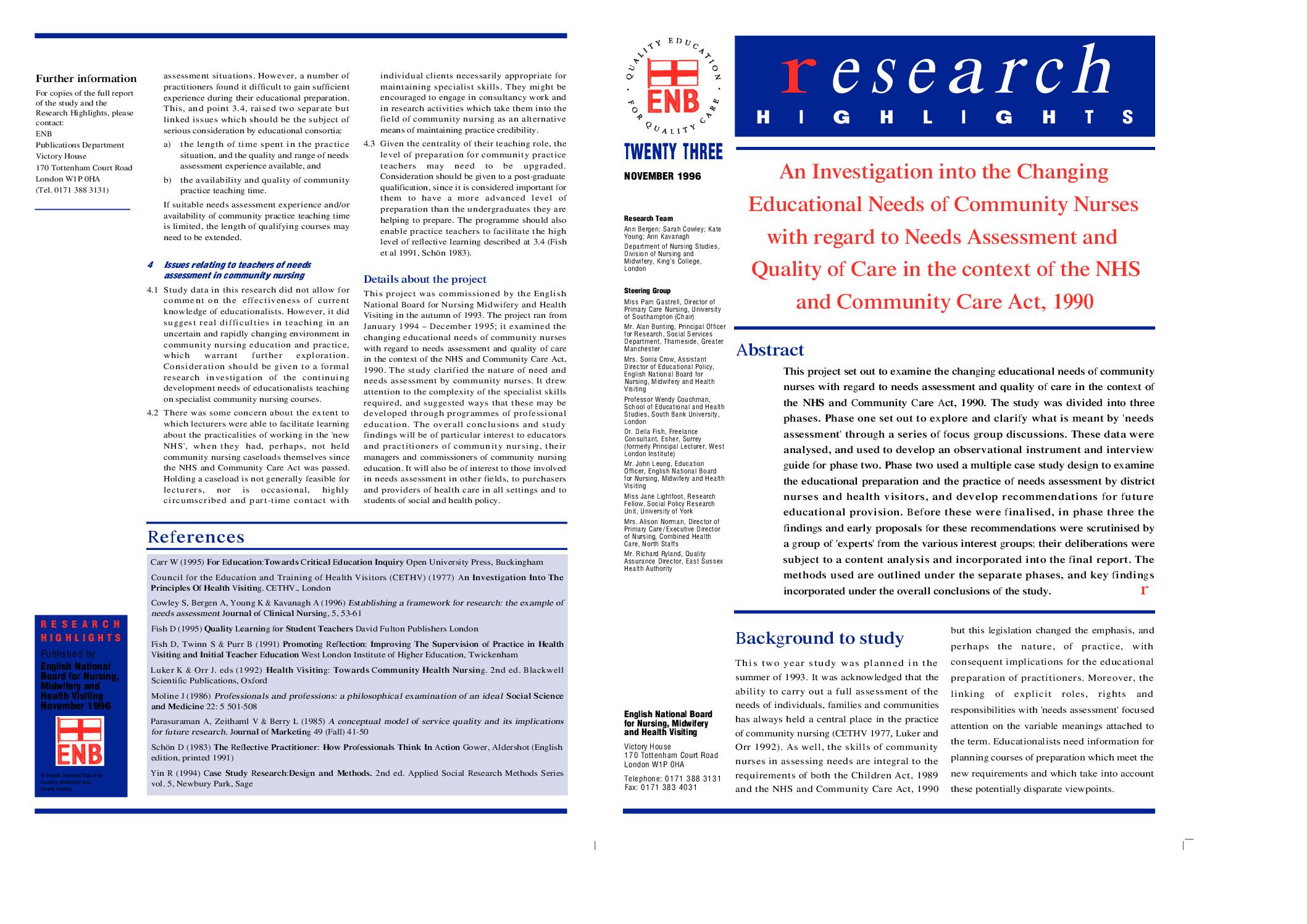
Bergen, A.; Cowley, S.; Young, K.; Kavanagh, A.
English National Board for Nursing, Midwifery and Health Visiting, Publications Department, Victory House, 170 Tottenham Court Road, London W1P 0HA, England, United Kingdom 1996, (ERIC Number: ED414484).
Abstract | BibTeX | Tags: Clinical Diagnosis, Community health services, Educational Needs, Foreign Countries, Medical Care Evaluation, Medical Evaluation, Medical Services, needs assessment, Nurses, Nursing Education, Postsecondary Education, Teacher Improvement
@techreport{bergen_investigation_1996,

title = {An Investigation into the Changing Educational Needs of Community Nurses with Regard to Needs Assessment and Quality of Care in the Context of the NHS and Community Care Act, 1990},

author = {A. Bergen and S. Cowley and K. Young and A. Kavanagh},

year  = {1996},

date = {1996-11-01},

urldate = {1996-11-01},

institution = {English National Board for Nursing, Midwifery and Health Visiting, Publications Department, Victory House, 170 Tottenham Court Road, London W1P 0HA, England, United Kingdom },

abstract = {A project examined the changing educational needs of community nurses in Britain with regard to needs assessment and quality of care in the context of the National Health Service and Community Care Act 1990.


Phase 1 clarified the term "needs assessment" through focus group discussions. Phase 2 used observations and interviews to examine educational preparation and practice of needs assessment by district nurses and health visitors and develop recommendations for future educational provision. In phase 3, a group of experts from interest groups scrutinized findings and proposals for recommendations that were subjected to a content analysis.


The ability to assess needs of individuals, families, and the local population served on the community nursing caseload appeared as a holistic endeavour. Certain aspects of needs assessment were learned better than others, perhaps due to a lack of clarity and understanding about some embedded features of need. Professional judgment required the development of critical skills and ability to conceptualise and articulate practice. The important role of the caseload-holding specialist teacher in the practice setting was highlighted.


Data suggested real difficulties in teaching in an uncertain and rapidly changing environment in community nursing education and practice. Upgrading the level of preparation for community practice teachers was recommended. (Appendixes include 250 references, discussion group materials, instruments, and data tables.) (YLB)},

note = {ERIC Number: ED414484},

keywords = {Clinical Diagnosis, Community health services, Educational Needs, Foreign Countries, Medical Care Evaluation, Medical Evaluation, Medical Services, needs assessment, Nurses, Nursing Education, Postsecondary Education, Teacher Improvement},

pubstate = {published},

tppubtype = {techreport}

}
Phase 1 clarified the term "needs assessment" through focus group discussions. Phase 2 used observations and interviews to examine educational preparation and practice of needs assessment by district nurses and health visitors and develop recommendations for future educational provision. In phase 3, a group of experts from interest groups scrutinized findings and proposals for recommendations that were subjected to a content analysis.
The ability to assess needs of individuals, families, and the local population served on the community nursing caseload appeared as a holistic endeavour. Certain aspects of needs assessment were learned better than others, perhaps due to a lack of clarity and understanding about some embedded features of need. Professional judgment required the development of critical skills and ability to conceptualise and articulate practice. The important role of the caseload-holding specialist teacher in the practice setting was highlighted.
Data suggested real difficulties in teaching in an uncertain and rapidly changing environment in community nursing education and practice. Upgrading the level of preparation for community practice teachers was recommended. (Appendixes include 250 references, discussion group materials, instruments, and data tables.) (YLB)
1990
Cowley, S
To the End of Their Days: Care of the Dying in Eastbourne's Health District Technical Report
Eastbourne Health Authority 1990.
BibTeX | Tags:
@techreport{cowley_end_1990,

title = {To the End of Their Days: Care of the Dying in Eastbourne's Health District},

author = {S Cowley},

year  = {1990},

date = {1990-01-01},

urldate = {1990-01-01},

institution = {Eastbourne Health Authority},

keywords = {},

pubstate = {published},

tppubtype = {techreport}

}